
PregSafeShop Knowledge Series · Chapter 1 – Understanding the science, regulations and quality systems behind the products you use.
How Is the Safety of Cosmetics Ensured Before They Reach the Market?
Many people imagine that cosmetic products are individually approved by a government authority before they reach store shelves. Others believe manufacturers simply create a formula, print a label and start selling it.
The reality lies somewhere in between.
In the European Union, cosmetic products are subject to one of the world’s most comprehensive regulatory frameworks. Before a cosmetic can legally be sold, its manufacturer must demonstrate that it is safe for its intended use. This process involves scientific evaluation, toxicological assessment, quality management, documentation, and continuous market surveillance.
At PregSafeShop, we believe that understanding this process is the best foundation for making informed decisions about skincare during pregnancy and for babies.
This article is the first in our PregSafeShop Knowledge Series, where we explore how cosmetic products are developed, evaluated and selected. Before discussing individual ingredients such as fragrance, essential oils or preservatives, we believe it is important to understand the system designed to protect consumers in the first place.
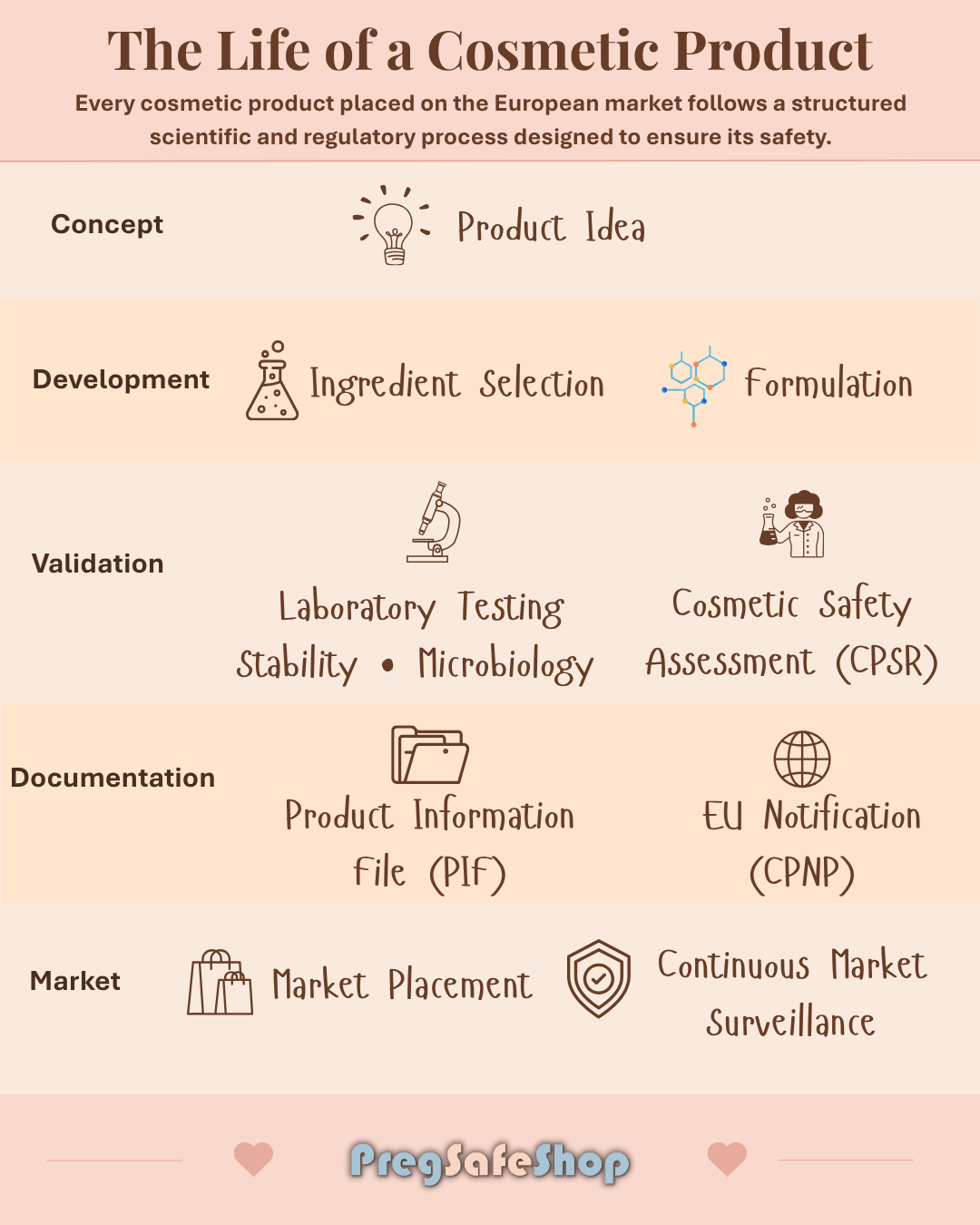
The Life of a Cosmetic Product
The biggest misconception about cosmetic safety
Most people imagine the process looks like this:
Manufacturer → Government laboratory → Approval → Store
In reality, the European system works differently.
Manufacturers are legally responsible for ensuring that every cosmetic product placed on the European market is safe for its intended use. Before a product can be sold, it must undergo a formal scientific safety assessment carried out by a qualified safety assessor. Authorities then oversee the market through inspections, audits, laboratory testing, and enforcement actions when necessary.
This distinction is important because it explains why cosmetic safety is based on scientific responsibility and continuous oversight, rather than on a single government approval.
Did you know?
Cosmetic products are not individually approved by EU authorities before they reach the market. Instead, manufacturers are legally responsible for demonstrating their safety.
Cosmetic safety is about the finished product—not just individual ingredients
A cosmetic product is not considered safe simply because each ingredient is individually acceptable. It is considered safe because the complete formulation has been scientifically assessed for its intended use, expected exposure, and target population.
What this means for pregnancy and baby care
Readers often ask whether a cosmetic is “safe” simply because it contains—or does not contain—a particular ingredient.
In reality, safety depends on many factors, including:
- the complete formulation,
- the concentration of each ingredient,
- how the product is used,
- how often it is used,
- and who will be using it.
This is one of the reasons why the same ingredient may be appropriate in one product and not in another.
This idea will become especially important when we later discuss fragrance, essential oils and preservatives.
What We Learned
After exploring how cosmetic products are evaluated before reaching the market, several key ideas stand out:
- Cosmetic products in the European Union are regulated under a comprehensive legal framework.
- Manufacturers are responsible for demonstrating the safety of their products before they are sold.
- Every product undergoes a scientific safety assessment based on its complete formulation and intended use.
- Authorities continue to monitor products after they reach the market through inspections, laboratory testing and consumer reports.
- Cosmetic safety is much more than reading an ingredient list.
Understanding these principles helps us evaluate cosmetic products with greater confidence and prepares us to explore individual ingredients with a more informed perspective.
Further Reading
The information presented in this article is based on current European cosmetic legislation, guidance from regulatory authorities, and scientific literature. If you would like to explore the topic in more detail, the following resources are excellent starting points:
European Legislation
- Regulation (EC) No 1223/2009 on Cosmetic Products
The main legal framework governing cosmetic safety in the European Union. - EUR-Lex – European Union Law
Official source for European legislation.
European Commission
- European Commission – Cosmetic Products
Overview of EU cosmetic legislation, responsibilities, and market surveillance. - Cosmetic Products Notification Portal (CPNP)
Information about the European notification system for cosmetic products.
Scientific Committee
- Scientific Committee on Consumer Safety (SCCS)
Independent scientific opinions on cosmetic ingredients and consumer safety.
Good Manufacturing Practices
- ISO 22716 – Cosmetics: Good Manufacturing Practices (GMP)
International standard describing best practices for cosmetic manufacturing.
Scientific Information
- Cosmetics Europe
Information about cosmetic science, ingredients, and industry practices.
At PregSafeShop, we believe that trust starts with understanding.
Our Knowledge Series is designed to explain cosmetic science and European regulations in a way that is accessible, evidence-based, and transparent. Whenever possible, we encourage readers to explore the original sources and make informed decisions with confidence.
Coming Next
What does “Parfum” really mean on a cosmetic ingredient list?
The word appears on thousands of products, yet it is also one of the most misunderstood ingredients in cosmetics. In the next chapter of the PregSafeShop Knowledge Series, we’ll explore what fragrance actually is, why manufacturers use it, how it is regulated, and what current scientific evidence tells us about its use during pregnancy and for babies.
Disclaimer: This article is intended for educational purposes and summarizes current scientific and regulatory knowledge at the time of publication. It should not replace personalized medical advice. If you are pregnant, breastfeeding, or have a medical condition, consult your healthcare professional regarding your individual situation.