

PregSafeShop Knowledge Series · Chapter 3
How Does Sunscreen Work? Understanding UV Filters, SPF and Sun Protection During Pregnancy
Sunlight plays an important role in our wellbeing. Spending time outdoors can improve our mood, encourage physical activity, and helps our bodies produce vitamin D. [5]
However, sunlight also contains ultraviolet (UV) radiation, an invisible form of energy that can affect our skin. While we cannot see or feel UV radiation itself, excessive exposure can damage skin cells over time. This is why protecting our skin from the sun is important for everyone—not just during holidays or at the beach, but whenever we spend extended periods outdoors.
Fortunately, protecting our skin does not mean avoiding the sun completely. Instead, it means enjoying the outdoors responsibly by combining shade, appropriate clothing, hats, sunglasses, and when needed, sunscreen.
Understanding UVA and UVB
Not all ultraviolet radiation is the same. The two types that reach the Earth’s surface and are most relevant to our skin are UVA and UVB.
UVA
UVA rays account for most of the UV radiation that reaches us throughout the year. They penetrate deeper into the skin and are associated with premature skin ageing, such as wrinkles and loss of skin elasticity. Because UVA intensity remains relatively constant throughout the day and can even pass through window glass, exposure occurs even when we are not sunbathing. [6]
UVB
UVB rays primarily affect the outer layers of the skin. They are the main cause of sunburn and play an important role in the development of skin cancer after repeated or excessive exposure. Unlike UVA, UVB intensity varies more with the season, time of day, and weather conditions. [5][6]
For effective protection, a sunscreen should provide broad-spectrum protection, meaning it protects against both UVA and UVB radiation.
Short-term and long-term effects of sun exposure
The effects of ultraviolet radiation are not always immediately visible.
In the short term, excessive sun exposure can lead to:
- Sunburn
- Skin redness and irritation
- Dehydration of the skin
Over many years, repeated exposure without adequate protection may contribute to:
- Premature skin ageing
- Pigmentation changes
- Loss of skin elasticity
- Increased risk of certain types of skin cancer [5][6]
These long-term effects result from the cumulative exposure our skin experiences throughout life, which is why consistent sun protection is considered an important part of healthy skincare.
Why should pregnant women and babies pay special attention?
Although the basic principles of sun protection apply to everyone, pregnancy and early childhood deserve particular attention.
During pregnancy, hormonal changes can make the skin more prone to hyperpigmentation, including a condition known as melasma or the “pregnancy mask.” Protecting the skin from ultraviolet radiation may help reduce the worsening of these pigment changes. [7]
Babies also have delicate skin that is still developing. Their natural protective mechanisms are not as mature as those of adults, making them more vulnerable to the effects of excessive sun exposure. For this reason, health authorities generally recommend keeping young babies out of direct sunlight whenever possible and using clothing, hats, shade, and age-appropriate sun protection as the first line of defence. [8]
How does sunscreen protect our skin?
When we apply sunscreen, we are not creating an impenetrable shield against the sun. Instead, sunscreen contains carefully selected ingredients called UV filters, whose purpose is to reduce the amount of ultraviolet (UV) radiation that reaches our skin.
These filters help prevent UV radiation from damaging skin cells, reducing the risk of sunburn and contributing to long-term skin protection. Different sunscreen products may use different combinations of UV filters to achieve broad-spectrum protection against both UVA and UVB radiation.
Today, sunscreens generally rely on two main categories of UV filters:
- Mineral (or inorganic) UV filters
- Organic (often called chemical) UV filters
Although they are often presented as competing technologies, both types are permitted for use in cosmetic products in the European Union, provided they meet strict safety requirements. [1][4]
The main difference lies in how they interact with ultraviolet radiation, not in their purpose. Both are designed to help protect the skin from the harmful effects of UV exposure.
Mineral UV filters
Mineral filters, such as zinc oxide and titanium dioxide, are tiny mineral particles that primarily protect the skin by reflecting and scattering part of the incoming UV radiation. Modern research has also shown that they can absorb a portion of UV radiation, making the overall mechanism more complex than was once believed. [3]
These filters are widely used in products intended for sensitive skin, babies, and people who prefer mineral-based formulations.
Organic UV filters
Organic UV filters work differently. Rather than primarily reflecting UV radiation, they absorb ultraviolet energy and convert it into a small amount of heat that is safely released from the skin.
There are many different organic UV filters, each designed to absorb specific parts of the UV spectrum. For this reason, manufacturers often combine several filters in one formulation to provide effective protection against both UVA and UVB radiation.
Why isn’t every sunscreen SPF 50?
One question many people ask is why sunscreens are available with different SPF values, such as SPF 30 or SPF 50.
The Sun Protection Factor (SPF) indicates how effectively a sunscreen protects the skin against UVB radiation, the type of ultraviolet radiation primarily responsible for sunburn. A higher SPF means that a greater proportion of UVB radiation is prevented from reaching the skin.
However, this does not necessarily mean that an SPF 50 sunscreen contains twice as many ingredients or is “twice as strong” as an SPF 30 product.
The level of protection depends on the overall formulation. Cosmetic scientists carefully combine different UV filters in specific concentrations to achieve the desired SPF while ensuring the product remains stable, spreads evenly on the skin, and feels pleasant to use.
An SPF 50 sunscreen may contain:
- higher concentrations of certain UV filters,
- a different combination of filters,
- or formulation improvements that increase the efficiency of the protection.
It is therefore not simply a matter of “adding more ingredients.”
One of the most misunderstood aspects of SPF is that the numbers are not linear.
Approximate protection under laboratory test conditions is often illustrated as:
| SPF | Approximate UVB blocked* |
|---|---|
| SPF 15 | ~93% |
| SPF 30 | ~97% |
| SPF 50 | ~98% |
Why does sunscreen contain so many ingredients?
At first glance, the ingredient list of a sunscreen may seem surprisingly long. This often leads to the question: Why does a sunscreen need so many ingredients?
The answer is that a sunscreen has to perform many different tasks at the same time.
It must provide reliable protection against UVA and UVB radiation, remain stable when exposed to heat and sunlight, spread evenly across the skin, resist water and perspiration, feel comfortable to wear, stay safe throughout its shelf life, and remain free from microbial contamination after the bottle has been opened.
Each of these characteristics depends on carefully selected ingredients that work together as part of a complete formulation. While UV filters are responsible for protecting the skin from ultraviolet radiation, other ingredients help keep the product stable, improve its texture, preserve its quality, or make it easier to apply evenly.
In other words, a sunscreen is much more than a collection of individual ingredients—it is the result of a carefully engineered formulation, where every component has a specific purpose.
Fortunately, modern cosmetic science allows these products to meet all of these requirements while complying with strict safety standards. Before a sunscreen reaches consumers, its ingredients and the final formulation must satisfy the requirements established by cosmetic regulations, helping ensure that the product is both effective and safe when used as intended. [1]
Baking a cake requires much more than flour. Eggs, butter, baking powder, milk and other ingredients each have a specific role in creating the final result. Removing one ingredient simply because the list seems “too long” would not necessarily make the cake better—it might stop it from working altogether. Sunscreens are similar: each ingredient contributes to making the product protective, stable, pleasant to use, and safe throughout its shelf life.
How are UV filters assessed in the European Union?
As we discussed in Chapter 1, cosmetic products sold in the European Union must comply with one of the world’s most comprehensive cosmetic regulations. This also applies to the UV filters used in sunscreen. [1]
Unlike many other cosmetic ingredients, UV filters are specifically regulated under the EU Cosmetics Regulation. This means that manufacturers cannot simply choose any ingredient and claim it protects against the sun. Only UV filters that have been scientifically evaluated and officially approved may be used in cosmetic products, and only under the conditions established by European legislation. [1][3][4]
Before a UV filter is approved, scientists evaluate a wide range of information, including:
- How effectively it protects against ultraviolet radiation.
- How the ingredient behaves when applied to the skin.
- Whether it remains stable when exposed to sunlight.
- Potential effects on human health under the intended conditions of use.
- The maximum concentration at which it can be used safely.
Only after this scientific assessment can a UV filter be included in the list of ingredients permitted for use in cosmetic products. [3]
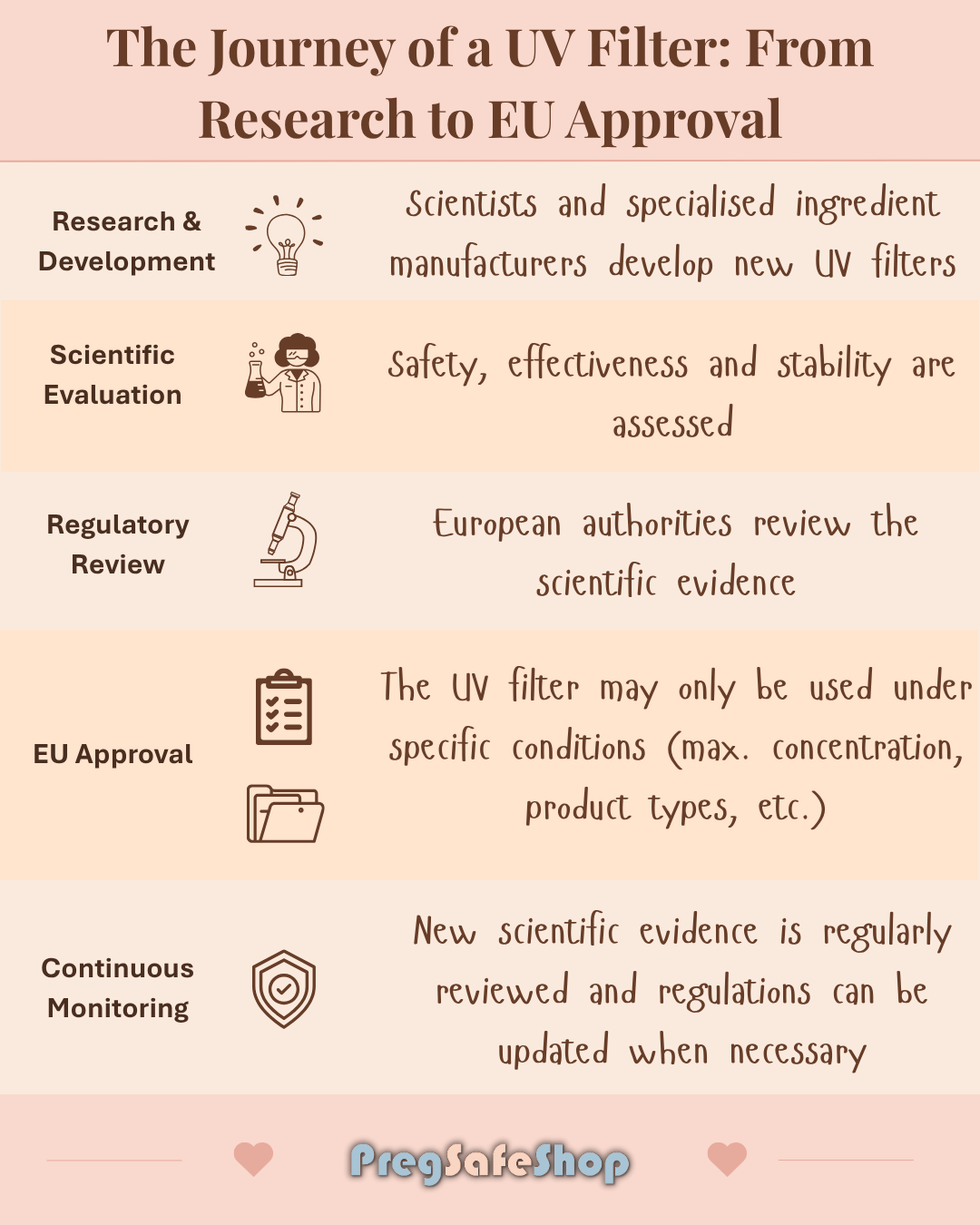
Importantly, the evaluation does not stop once an ingredient is approved. Scientific knowledge continues to evolve, and regulatory authorities regularly review new evidence. If necessary, the conditions of use can be updated or an ingredient can be restricted or removed from the list of approved UV filters. [1][3][4]
This ongoing scientific oversight helps ensure that sunscreen products available to European consumers continue to meet high standards of safety and performance.
Did you know?
Some UV filters approved for use in Europe are not available in sunscreens sold in the United States. This is mainly because sunscreens are regulated differently in the two regions. In the EU, they are regulated as cosmetics, while in the US they are regulated as over-the-counter drugs. As a result, the approval processes are different and may not progress at the same pace. [1]
Who develops UV filters?
Most cosmetic brands do not invent the UV filters used in their sunscreens. Instead, these ingredients are typically developed by specialized chemical companies with expertise in fields such as chemistry, toxicology, photobiology, and materials science.
Developing a new UV filter is a lengthy scientific process that can take many years. Once approved by regulatory authorities, these ingredients become available for cosmetic formulators, who carefully combine them with other ingredients to create sunscreens that provide effective protection while remaining stable, pleasant to use, and suitable for different skin types.
In other words, creating a sunscreen is a collaborative effort. Specialised ingredient manufacturers develop the UV filters, while cosmetic brands apply their formulation expertise to transform those ingredients into safe and effective finished products.
Choosing Sun Protection During Pregnancy and for Babies
Sun protection is important for everyone, but pregnancy and early childhood present a few additional considerations. While the principles of protecting the skin remain the same, choosing and using sunscreen thoughtfully can help make outdoor activities both enjoyable and safe.
During pregnancy
Hormonal changes during pregnancy can make the skin more sensitive to sunlight and increase the likelihood of developing areas of darker pigmentation, commonly known as melasma or the “pregnancy mask.” Although these changes are usually harmless, they can become more noticeable with prolonged sun exposure.
For this reason, healthcare professionals generally recommend combining several protective measures whenever spending time outdoors: [7][8]
- Seeking shade whenever possible, particularly during the strongest hours of sunlight.
- Wearing protective clothing, a wide-brimmed hat, and sunglasses.
- Applying a broad-spectrum sunscreen to exposed skin and reapplying it as directed.
Rather than relying on sunscreen alone, combining several forms of protection offers the best overall defence against UV radiation.
Protecting babies and young children
Babies and young children have delicate skin that is still developing and can be more vulnerable to the effects of ultraviolet radiation.
For infants, many health authorities recommend avoiding direct sun exposure whenever possible, especially during the first months of life. Shade, lightweight protective clothing, hats, and sunshades are considered the primary methods of protection. [8]
As children become older and spend more time outdoors, sunscreen becomes an important addition to these protective measures. Products specifically formulated for children or sensitive skin may be a suitable choice, but the most important factor remains using the sunscreen correctly and applying enough to achieve the intended level of protection.
Choosing the right sunscreen
There is no single “perfect” sunscreen for every person or every situation. Instead, choosing a product often depends on factors such as skin type, planned activities, and personal preference.
When selecting a sunscreen, it is generally recommended to look for:
- Broad-spectrum protection, covering both UVA and UVB radiation. [7]
- An appropriate SPF, depending on your needs and expected sun exposure.
- A product that you find comfortable to wear, making regular use more likely.
Remember that even the most advanced sunscreen cannot provide its intended protection if too little is applied or if it is not reapplied after swimming, heavy perspiration, or prolonged time outdoors. [7]
Cream, lotion, stick or spray?
Sunscreens are available in several formats, and each offers practical advantages.
- Creams are easy to see during application and are often preferred for babies and young children.
- Lotions spread easily over larger areas of the body.
- Sticks are particularly useful for the face, nose, ears and around the eyes.
- Sprays allow quick application but should be used carefully to avoid inhalation. When applying sunscreen to a child’s face, many healthcare professionals recommend spraying the product into your hands first and then gently applying it to the skin. [7][8]
The choice of format is largely a matter of convenience and personal preference. What matters most is applying the sunscreen generously, covering all exposed areas, and reapplying it as recommended.
Understanding how sunscreen works is only one part of staying protected outdoors. During pregnancy, factors such as hydration, heat, clothing and choosing the right time of day to be outside are equally important. If you’re looking for practical advice beyond sunscreen, we’ve also prepared a guide with everyday tips for enjoying the summer safely during pregnancy.
Read also: Summer Pregnancy Care – Essential Tips for Moms, Babies and Young Children.
🌸 How We Think at PregSafeShop
At PregSafeShop, we believe that understanding cosmetics begins with understanding formulations, not just individual ingredients.
Sunscreens are a great example. They are among the most carefully engineered cosmetic products available today, combining UV filters with many other ingredients that each contribute to the product’s safety, stability, effectiveness, and ease of use.
Rather than judging a sunscreen by the length of its ingredient list or focusing on a single ingredient in isolation, we encourage looking at the product as a whole. A well-formulated sunscreen is the result of scientific research, careful testing, and strict regulatory oversight.
Our goal is not to tell you which products to fear or which products to trust blindly. Instead, we hope to give you the knowledge to understand how these products are designed, assessed, and used—so you can make informed decisions with confidence.
Final thoughts
Sunscreen is one of the most scientifically advanced cosmetic products we use every day.
An effective sunscreen must protect against different types of ultraviolet radiation, remain stable under sunlight, feel comfortable on the skin, resist water and perspiration, and remain safe throughout its shelf life. Achieving all of this requires carefully selected ingredients working together as a complete formulation.
Rather than judging a sunscreen by the length of its ingredient list or the complexity of individual ingredient names, it is more meaningful to understand the science behind its formulation and the rigorous safety assessments required before it reaches consumers.
Combined with sensible sun habits, sunscreen remains one of the most effective tools for protecting our skin and enjoying time outdoors safely.
References
[1] European Parliament and Council. Regulation (EC) No 1223/2009 on Cosmetic Products. European Union.
[2] European Commission. CosIng – Cosmetic Ingredients Database. European Commission.
[3] Scientific Committee on Consumer Safety (SCCS). Opinions on UV Filters. European Commission.
[5] World Health Organization (WHO). Ultraviolet Radiation and Health.
[6] International Agency for Research on Cancer (IARC). Solar and Ultraviolet Radiation.
[7] American Academy of Dermatology (AAD). How to Select and Use Sunscreen.
[8] American Academy of Pediatrics (AAP). Guidance on Sun Safety for Infants and Children.
Reference note: Throughout this article, statements about cosmetic regulation are based primarily on European Union legislation and opinions published by the Scientific Committee on Consumer Safety (SCCS). Health-related recommendations are supported by guidance from recognized public health and medical organizations.
About the PregSafeShop Knowledge Series
The PregSafeShop Knowledge Series aims to explain cosmetic science in a clear, balanced and evidence-based way. Rather than telling readers what to think, our goal is to help parents understand how cosmetic products are developed, assessed and regulated, empowering them to make informed decisions with confidence.
Disclaimer. This article is part of the PregSafeShop Knowledge Series, created to provide evidence-based educational information about cosmetics, skincare and pregnancy. The information presented is intended for general educational purposes only and should not be considered a substitute for personalised medical advice, diagnosis or treatment. If you have specific questions about your health, pregnancy or your child’s wellbeing, please consult your doctor, midwife or another qualified healthcare professional. Scientific knowledge and cosmetic regulations continue to evolve. While we strive to keep our content accurate and up to date, recommendations and regulatory requirements may change as new evidence becomes available.