
PregSafeShop Knowledge Series · Chapter 4
What Are Essential Oils?
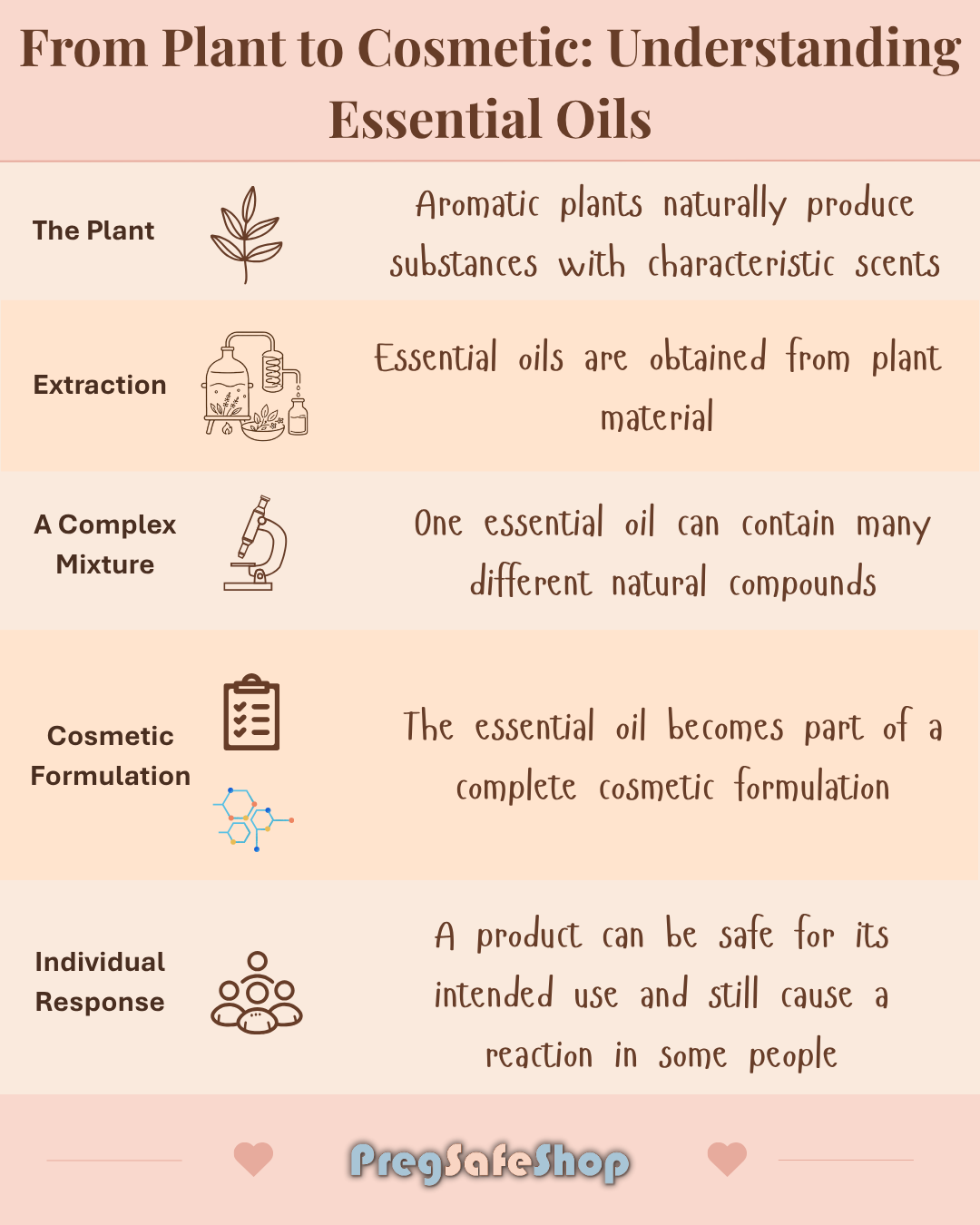
Essential oils are concentrated, aromatic substances obtained from plants. They can be obtained from different parts of a plant — such as flowers, leaves, fruits, peels, bark or roots — using methods such as distillation or mechanical pressing, particularly for some citrus oils. [1]. They contain a complex mixture of naturally occurring volatile compounds that gives the plant its characteristic aroma. [1]
The word “essential” can be slightly misleading. It does not mean that these oils are essential for the plant’s survival, or that they are essential nutrients for our bodies. Rather, the term refers to the characteristic “essence” or aroma of the plant. [1]
A tradition thousands of years old
The use of aromatic plants and plant-derived oils is far from new. Ancient civilizations, including those of Egypt and the Mediterranean, used aromatic plants, resins and scented oils thousands of years ago for perfumes, cosmetics, religious rituals and traditional preparations. Archaeological evidence shows that scented oils and other aromatic preparations were already being produced and traded in the ancient world. [2][3][7]
However, there is an important distinction between these historical preparations and the essential oils used in modern cosmetics.
The techniques used to extract, analyse and standardise essential oils have developed considerably over time. Today, scientists can identify many of the individual chemical components within an essential oil and study their properties, stability and potential effects on the skin.
In other words, the history of using aromatic plants may stretch back thousands of years, but our scientific understanding of what is actually contained in these preparations is much more recent.
This distinction will become important throughout this chapter. An essential oil may be natural and have a long history of traditional use, but that alone does not tell us whether a particular cosmetic product is safe or suitable for a particular person. As with any cosmetic ingredient, safety depends on the substance itself, its concentration, how it is formulated, and how the finished product is used.
Why Are Essential Oils Used in Cosmetics?
Essential oils have a long history of use in perfumes and personal care, and one of their most familiar roles in modern cosmetics is fragrance. They contain naturally occurring aromatic compounds that can give a product a distinctive scent and contribute to its sensory character. [1][2]
However, essential oils are not simply interchangeable with one another. Lavender oil, lemon oil, peppermint oil and tea tree oil, for example, are chemically different materials, with different compositions and therefore different characteristics. The European Commission and the Scientific Committee on Consumer Safety (SCCS) have assessed individual essential oils and fragrance materials separately because their safety profiles can differ. [2][3][5]
Essential oils may therefore be included in a cosmetic formulation for their fragrance or other cosmetic functions, depending on the particular ingredient and how it is used. But it is important not to confuse a traditional use or a commonly claimed property with a scientifically established health effect.
The amount used in a cosmetic formulation also matters. A finished cosmetic containing a carefully controlled concentration of an essential oil is not the same exposure as applying a concentrated essential oil directly to the skin. Safety assessments consider the conditions under which an ingredient is actually used in a cosmetic product. [3][4]
Why not simply use synthetic fragrance?
There is no general rule that says a natural fragrance is better or safer than a synthetic one — or vice versa.
Fragrance ingredients can come from natural sources or chemical synthesis, and both types may contain substances that are relevant to fragrance safety. What matters is the identity of the substances, their concentration, the exposure, and how they are used in the finished product. [2]
For a cosmetic formulator, the choice between an essential oil and other fragrance materials can depend on factors such as the desired scent, formulation compatibility, stability, sensory properties and regulatory requirements.
This is one reason why looking at one ingredient in isolation can be misleading. The same essential oil can have different safety considerations depending on its concentration, the other ingredients in the formulation, and the type of finished cosmetic product. [3][4]
And this brings us to one of the most important questions surrounding essential oils:
If they come from plants and have been used for thousands of years, does that automatically make them safer?
Not necessarily.
Natural origin tells us where an ingredient comes from. It does not, by itself, tell us how an ingredient will behave on the skin or how safe a particular exposure will be.
That is the question we will explore in the next section.
Natural Doesn’t Automatically Mean Risk-Free
The word “natural” has a powerful appeal in cosmetics. It can suggest something gentle, pure and closer to nature. But from a scientific perspective, natural origin does not automatically tell us whether an ingredient is safe, effective or suitable for everyone.
Plants produce thousands of different chemical substances. Some are useful, some are biologically active, and some can irritate the skin or cause allergic reactions. Essential oils are particularly interesting in this respect because they are concentrated mixtures of many naturally occurring compounds, rather than simply “plant extracts in liquid form.” [1][2]
This does not make essential oils bad ingredients. It simply means that their safety needs to be considered in the same thoughtful way as other cosmetic ingredients.
Did you know?
The same essential oil can have a different chemical composition depending on where and how the plant was grown and processed.
Factors such as geographical origin, climate, plant variety and extraction method can influence the composition of the resulting oil.
Natural and synthetic are not opposites when it comes to safety
It is sometimes tempting to divide cosmetic ingredients into two groups:
Natural = good
Synthetic = bad
But chemistry does not work that way.
A substance’s origin does not determine its safety. A naturally occurring substance and a synthetically produced substance can have the same chemical structure and therefore the same chemical properties. Conversely, two substances that both come from plants can have completely different effects on the skin. [2]
This is why cosmetic scientists and regulators look beyond the question of whether an ingredient is “natural.” They consider factors such as the identity of the substance, its concentration, how it is used, the duration and frequency of exposure, and the characteristics of the finished product. [3][4]
Concentration matters
An essential oil is a concentrated material. The fact that a plant may contain a particular aromatic compound naturally does not mean that applying a concentrated preparation of that compound to the skin is equivalent to encountering the plant itself.
The same principle applies inside a cosmetic formulation. An essential oil may be present at a relatively low concentration and combined with many other ingredients in a product specifically formulated for application to the skin.
This is why it is important to distinguish between an ingredient and the finished cosmetic product containing that ingredient.
A cosmetic safety assessment does not simply ask:
“Is this ingredient natural?”
It asks a much more useful question:
“Is this finished product safe when used as intended?” [3][4]
Natural ingredients can still be biologically active
Another important point is that “natural” does not mean “inactive.”
Many essential oils contain compounds that interact with biological systems. This is part of what makes them interesting ingredients, but it is also why their concentration and conditions of use matter.
For example, some essential-oil components can be relevant to skin irritation or sensitisation in susceptible individuals. The Scientific Committee on Consumer Safety (SCCS) has specifically assessed a number of fragrance substances and essential oils because of their potential to cause contact allergy or other adverse effects under certain conditions of exposure. [2]
This brings us to an important principle that we will return to throughout this article:
🌿 Natural describes where an ingredient comes from. It does not describe how safe it is.
The same principle works in the opposite direction:
🧪 Synthetic describes how a substance is produced. It does not automatically mean that it is harmful.
What matters is the substance, the dose, the exposure and the way the finished product is formulated and used.
And this is exactly why looking at a cosmetic ingredient list requires a little more context than simply counting how many ingredients are “natural.”
Can Essential Oils Still Irritate the Skin?
Even when an essential oil is used in a cosmetic product that complies with European cosmetic safety requirements, some people may still experience a skin reaction.
This does not necessarily mean that the product is unsafe or that the ingredient should not have been used. Cosmetic safety assessments consider whether a product can be considered safe under its intended conditions of use. They cannot guarantee that every individual will respond to every cosmetic product in exactly the same way. [3][4]
There are two important ways in which the skin can react: irritation and allergic contact dermatitis.
Irritation is not the same as an allergy
Irritant contact dermatitis occurs when something directly irritates or damages the skin. Symptoms can include dryness, redness, burning, stinging or discomfort. The reaction can depend on factors such as the substance involved, its concentration, how often the skin is exposed, and the condition of the skin. [2][3]
Allergic contact dermatitis is different. Here, the immune system becomes sensitised to a particular substance. Once someone has become sensitised, subsequent exposure can trigger an inflammatory skin reaction. Symptoms can include itching, redness, swelling and sometimes blistering. The reaction may also be delayed, appearing hours or even days after exposure. [3][4]
Some fragrance substances found naturally in essential oils are known contact allergens. The SCCS has identified a number of natural extracts, including essential oils, that can cause contact allergy in susceptible individuals. [2]
This is one reason why the European Union requires certain fragrance allergens to be listed individually on the ingredient label when their concentration in the finished cosmetic reaches a specified labelling threshold. These thresholds are intended to ensure that consumers who are already sensitised to a particular fragrance allergen can identify its presence in a cosmetic product. They are not simply limits above which the ingredient becomes unsafe. [2][5]
For example, if a finished cosmetic contains Linalool at a concentration that reaches the applicable threshold for individual declaration, Linalool must appear separately in the ingredient list. If its concentration remains below that threshold, it does not need to be individually declared as a fragrance allergen, although the substance may still be present in the formulation. [2][5]
Why can this happen if the product is considered safe?
This is an important distinction.
When a cosmetic product is considered safe for its intended use, this means that its safety has been assessed under the relevant conditions of use. It does not mean that every individual will necessarily tolerate the product without a reaction.
People have different skin characteristics and different histories of exposure. A person may also develop sensitisation to an ingredient over time. In addition, the condition of the skin can influence how it responds to exposure. [3][4]
So a skin reaction does not automatically mean:
“The cosmetic was unsafe.”
Nor does it mean:
“Essential oils are unsafe.”
It may simply mean that this particular person did not tolerate this particular formulation or one of its ingredients.
What should you do if your skin reacts?
If a cosmetic product causes unexpected burning, itching, redness or another skin reaction, the sensible first step is to stop using the product.
For a mild reaction, avoiding the suspected product and allowing the skin to recover may be sufficient. If the reaction is persistent, severe, widespread, or you are unsure what caused it, it is appropriate to seek advice from a healthcare professional. [3][7]
If a reaction keeps recurring or the cause is difficult to identify, a dermatologist may recommend patch testing. This can help determine whether a particular ingredient is responsible for allergic contact dermatitis. [10]
And this is where the ingredient list becomes particularly useful. If you discover that you are sensitised to a particular fragrance allergen, being able to identify that substance in future cosmetic products can help you avoid further exposure.
🌿 A useful rule of thumb
A product can be safe for general use and still not be suitable for every individual.
If your skin reacts, listen to your skin rather than assuming that “natural” or “approved” means you should continue using the product.
Essential Oil vs. Essential-Oil-Containing Cosmetic
One of the most important distinctions when discussing essential oils is the difference between the essential oil itself and a finished cosmetic product that contains an essential oil as one of its ingredients.
These are not necessarily equivalent exposures.
An essential oil is a concentrated mixture of naturally occurring compounds obtained from plant material. Used on its own, the concentration of its constituents can be very different from the concentration present in a finished cosmetic product.
A cosmetic formulation, on the other hand, may contain an essential oil together with water, oils, emulsifiers, humectants, preservatives and other ingredients. The essential oil is therefore only one component of the complete formulation.
Concentration matters
Consider a simple example.
Imagine that a cosmetic contains 1% of a particular essential oil. This means that the finished product contains that essential oil at a defined concentration, together with the rest of the formulation.
Applying the finished cosmetic to the skin is therefore not the same exposure as applying the undiluted essential oil directly to the skin.
This distinction is important because the potential effects of an ingredient depend not only on its identity, but also on factors such as concentration, frequency of use, area of application and the way the product is used. [1][2]
The finished formulation matters too
The other ingredients in a cosmetic are not simply “fillers”.
They can influence how the product behaves on the skin, how easily it spreads, how stable it remains, and how the ingredients are delivered during use.
This is why cosmetic safety cannot always be judged by looking at one ingredient in isolation.
A formulation containing an essential oil has to be considered as a complete cosmetic product, including its composition and intended conditions of use. The EU cosmetic safety framework requires the finished product to undergo a safety assessment before it is placed on the market. [3]
This does not mean that more diluted always means harmless
It is also important not to take this distinction too far.
A lower concentration generally means a different level of exposure, but dilution does not automatically eliminate the possibility of irritation or sensitisation.
For someone who is already sensitised to a particular fragrance allergen, even relatively low exposure may potentially trigger a reaction. This is one reason why the identity of the substances present in an essential oil, as well as their concentration in the finished product, matters. [2][4]
So when evaluating a cosmetic containing essential oils, the more useful questions are not simply:
“Does this product contain essential oils?”
but rather:
Which essential oil or oils are listed?
What other ingredients are present in the formulation?
How is the finished product intended to be used?
Who is the product intended for?
Has the finished formulation been appropriately assessed for safety?
The exact concentration of an essential oil is generally not available from the INCI list, as cosmetic manufacturers do not normally have to disclose the precise percentage of each ingredient. The safety assessor, however, has access to the formulation information needed to evaluate the product under its intended conditions of use. [3]
This distinction is important: The INCI list provides valuable information about the cosmetic’s ingredients, but the complete formulation and exact concentrations are not normally disclosed on the product label.
Essential Oils During Pregnancy
Pregnancy naturally makes many people more cautious about the products they use. When essential oils are involved, it is useful to distinguish between effects on the mother’s skin and the separate question of possible effects associated with systemic exposure during pregnancy.
As we have seen, essential oils are concentrated mixtures containing many different compounds. Their safety therefore cannot be assessed simply by asking whether an ingredient is “natural” or whether it is an essential oil. The specific substance, concentration, route of exposure and intended use all matter. [1][2]
Skin sensitivity is one consideration
Pregnancy can bring changes to the skin, including increased sensitivity and a greater tendency towards pigmentation changes. This means that some pregnant women may find that their skin reacts differently to cosmetic products than it did before pregnancy. [9]
Irritation or allergic contact dermatitis can therefore be a consideration when using products containing essential oils, just as it can be for anyone else. However, this is primarily a question of how the mother’s skin responds to the product, rather than a question of harm to the developing baby. [3][4]
But skin sensitivity is not the only reason for taking a thoughtful approach during pregnancy.
What about the developing baby?
Some substances found in essential oils are biologically active, and researchers have investigated whether certain essential-oil constituents can affect reproductive function or fetal development.
Experimental studies have raised concerns for some constituents, including thujone, pulegone, camphor, methyl salicylate, citral and anethole. Reported effects in the scientific literature include reproductive toxicity, changes in reproductive hormones and developmental or embryo-fetal effects. [8]
However, an important qualification is needed: evidence of a potential hazard in experimental studies does not automatically mean that using a cosmetic containing an essential oil will cause harm during pregnancy.
Many of these findings come from animal, laboratory or other experimental studies, and the exposure conditions can be very different from those associated with a properly formulated cosmetic applied to the skin. For many individual essential oils, robust human pregnancy data are limited. [6][8]
This means that it would be misleading to conclude either that all essential oils are dangerous during pregnancy or that all essential oils are proven to be harmless.
The scientifically more useful approach is to consider the specific ingredient and the actual exposure.
Cosmetic use is different from concentrated essential oils
As discussed in the previous section, applying a finished cosmetic containing an essential oil is not the same exposure as applying a concentrated essential oil directly to the skin.
The amount present in the finished formulation, the area of application, the frequency of use and how the product is used all influence exposure. The complete cosmetic formulation is assessed for its intended conditions of use, although the exact concentration of individual ingredients is generally not disclosed on the product label. [1][2]
This distinction is particularly important during pregnancy.
A body lotion containing a small amount of an essential oil represents a different exposure scenario from deliberately applying concentrated essential oil directly to the skin, ingesting an essential oil, or using an essential oil through another route that may result in different or greater systemic exposure.
What about aromatherapy?
Aromatherapy and cosmetic use should not automatically be treated as the same thing.
Inhalation, massage with concentrated oils, oral use and other forms of aromatherapy involve different exposure routes and may result in different levels of exposure. Evidence or recommendations concerning one route should therefore not automatically be applied to another. [2]
For this reason, pregnant women considering concentrated essential oils, oral use, or essential-oil-based aromatherapy practices should seek advice from an appropriate healthcare professional rather than assuming that information about ordinary cosmetic use applies to all situations.
So, should pregnant women avoid essential oils?
There is no scientifically justified blanket rule that all essential oils must be avoided during pregnancy.
At the same time, pregnancy is a reasonable reason to be particularly thoughtful about concentrated essential oils and non-cosmetic uses, especially when the exposure route or safety information is uncertain.
For ordinary cosmetic products, a more useful approach is to consider:
- Which essential oil or constituents are present?
- What is the intended use of the finished cosmetic?
- How is the product applied and how frequently?
- Is the product formulated and assessed for its intended cosmetic use?
- Are there specific safety concerns associated with the particular ingredient?
The important point is that “contains essential oils” is not, by itself, enough information to determine whether a cosmetic is appropriate during pregnancy.
And this is precisely why understanding the difference between an essential oil, its individual constituents and the finished cosmetic formulation matters.
Essential Oils in Baby Products
When it comes to babies, the question of essential oils deserves particular care.
Babies’ skin is still developing, and their skin barrier and body systems are not identical to those of adults. Their smaller body size can also result in greater exposure relative to body weight when the same amount of a substance is applied. For these reasons, products intended specifically for babies are generally formulated with their particular needs and intended use in mind. [1][2][4]
Essential oils are not automatically inappropriate — but context matters
The presence of an essential oil in a baby product does not, by itself, tell us whether the product is safe or unsuitable.
As with other cosmetic ingredients, the relevant questions include which substances are present, their concentration in the finished formulation, how the product is used, and who it is intended for.
At the same time, babies may be more vulnerable to certain types of exposure, and there is less safety information available for many essential oils specifically in infants. This is one reason why concentrated essential oils should not simply be treated as equivalent to a finished cosmetic formulated for babies.
A baby oil is not the same as an essential oil
The word “oil” can also create confusion.
A baby oil or a pregnancy oil is a finished cosmetic formulation, not necessarily a concentrated essential oil. It may contain vegetable oils, emollients and other cosmetic ingredients, and some products may also contain essential oils at specific concentrations.
For example, a product described as a baby massage oil is referring to the finished cosmetic and its intended use — not to a bottle of concentrated essential oil.
This distinction is important because the safety of a finished cosmetic depends on its complete formulation and intended conditions of use, rather than simply on whether the word “oil” appears in its name.
What about fragrance and essential oils?
Another point worth remembering is that a product can contain fragrance-related ingredients without necessarily containing an essential oil.
Likewise, an essential oil can contribute fragrance compounds to a cosmetic.
This is one reason why looking at the INCI list is more informative than relying on terms such as “natural,” “botanical,” “aromatic” or simply “oil” on the front of the packaging.
We will return to this in more detail when we look at how essential oils and their constituents can appear in an INCI list.
Should essential oils be avoided in baby products?
There is no useful scientific rule that says that every cosmetic containing an essential oil is automatically unsuitable for babies.
However, because infants are a specific and more vulnerable user group, the intended age group and the safety assessment of the finished product are particularly important.
Concentrated essential oils should not be applied directly to a baby’s skin simply because they are natural or because they are used in adult cosmetics.
For products specifically formulated and marketed for babies, it is more appropriate to consider the finished formulation, intended use, age group and applicable safety requirements.
And, as always, following the manufacturer’s directions for use is important — particularly for products intended for very young children.
A simple way to think about it
When looking at a baby product containing an essential oil, the question does not need to be:
“Does it contain an essential oil — yes or no?”
A better starting point is:
“What is the finished product, who is it intended for, how is it used, and has that particular formulation been assessed for that intended use?”
This is the same principle we have applied throughout this article: ingredients matter, but context matters too.
How Are Essential Oils Assessed in the EU?
In Chapter 1 of the PregSafeShop Knowledge Series, we looked at how cosmetic safety is ensured in the European Union — including the responsibilities of manufacturers, the safety assessment required before a cosmetic product is placed on the market, and the role of EU legislation and scientific evaluation.
Essential oils are subject to this same regulatory framework. There is no separate category of “natural” ingredients that bypasses the normal cosmetic safety requirements simply because an ingredient comes from a plant.
What makes essential oils particularly interesting is their complex composition.
Essential oils are complex mixtures
Unlike a single, well-defined chemical substance, an essential oil can contain many different naturally occurring compounds. The exact composition can also vary depending on factors such as the plant species, geographical origin, plant part used and production method.
For the safety assessment, therefore, it is not enough to simply write “essential oil” and consider the matter settled.
The relevant constituents of the essential oil, their toxicological properties and the way the finished cosmetic is used all need to be considered as part of the overall safety assessment. [1][2]
The conditions of use matter
As we have seen throughout this article, exposure matters.
The safety assessment of a cosmetic containing an essential oil takes into account factors such as:
- the concentration used in the finished product;
- whether the product is leave-on or rinse-off;
- the area of the body where it is applied;
- the frequency and duration of use;
- the intended user group; and
- the potential for skin sensitisation and other relevant toxicological effects. [1][2]
This is one reason why the same essential oil cannot simply be described as “safe” or “unsafe” without specifying how and where it is being used.
The EU can impose specific restrictions
The EU Cosmetics Regulation contains restrictions for certain substances used in cosmetics, and these restrictions can apply to substances that occur naturally in essential oils.
In other words, the fact that a substance occurs naturally in an essential oil does not prevent it from being subject to regulatory limits or other conditions of use.
The regulatory framework can also evolve when new scientific evidence becomes available. The Scientific Committee on Consumer Safety (SCCS) may be asked to evaluate specific substances or ingredients when a scientific safety assessment is needed. [3]
A real example: tea tree oil
A useful real-world example is the Scientific Committee on Consumer Safety (SCCS) assessment of tea tree oil. In its 2025 scientific opinion, the SCCS assessed tea tree oil in specific cosmetic applications and concentrations, taking into account factors including its composition, stability, skin-sensitising potential and the intended conditions of use. [6]
Importantly, the SCCS did not simply answer the question “Is tea tree oil safe?” Instead, its conclusion depended on specific concentrations, product types, intended users and exposure routes. The opinion applies to dermally applied products intended exclusively for adults and does not cover aerosolised or sprayable products. [6]
This is a good illustration of how cosmetic safety assessment works in practice:
The question is not simply whether an essential oil is “natural” or “safe”. The relevant question is whether a particular use, at a particular concentration, in a particular cosmetic product, can be considered safe for its intended conditions of use.
How to Recognise Essential Oils in an INCI List
If you want to know whether a cosmetic contains an essential oil, the INCI list is one of the most useful places to look. However, it cannot always reveal the full composition of a fragrance mixture.
When an essential oil is declared as an individual cosmetic ingredient, it is listed using its standardised cosmetic ingredient name, so you will not necessarily see the words “essential oil” written next to the ingredient.
Look for the botanical name
Many essential oils are identified by the botanical name of the plant from which they are obtained.
For example:
- Lavandula Angustifolia Oil — lavender oil
- Melaleuca Alternifolia Leaf Oil — tea tree oil
- Citrus Limon Peel Oil — lemon peel oil
- Mentha Piperita Oil — peppermint oil
- Eucalyptus Globulus Leaf Oil — eucalyptus oil
The exact INCI name can vary depending on the plant and the part used, so recognising some of the common naming patterns can be helpful.
Essential oils and fragrance allergens are not the same thing
This is an important distinction.
An essential oil can contain naturally occurring substances that are recognised as fragrance allergens. Some of these substances may therefore appear separately in the INCI list when the applicable EU labelling requirements are met.
For example, an essential-oil-containing product might list an essential oil such as:
Lavandula Angustifolia Oil
and also contain declared fragrance allergens such as:
Linalool or Limonene.
This does not necessarily mean that the manufacturer has added those substances separately. They may occur naturally as constituents of the essential oil.
The presence of a fragrance allergen in the INCI list therefore does not automatically tell you whether it was added as an isolated ingredient or is naturally present in another ingredient such as an essential oil. [2]
What the INCI list can — and cannot — tell you
The INCI list can help you identify which ingredients are present, including many essential oils and individual fragrance allergens.
However, as we discussed earlier, it generally does not tell you the exact concentration of each ingredient. Ingredients present at concentrations of 1% or more are generally listed in descending order of weight, while ingredients below 1% may be listed in any order after them. [3][4]
This means that the position of an essential oil in the ingredient list can sometimes provide useful context, but it should not be interpreted as its exact concentration.
And an INCI list cannot tell you everything about how the finished cosmetic was assessed for safety.
A practical example
Imagine you find this in an ingredient list:
Aqua, Glycerin, Caprylic/Capric Triglyceride, Lavandula Angustifolia Oil, …
You can reasonably conclude that the product contains lavender essential oil.
But from this list alone, you cannot determine its precise percentage.
Likewise, if you see:
Limonene, Linalool
you cannot automatically conclude that these were added separately as fragrance ingredients. They may be constituents of an essential oil or another fragrance material used in the formulation.
This is why reading an INCI list is useful, but interpreting it requires some context.
A final tip when reading cosmetics
If you are specifically trying to identify essential oils, don’t look only for the words “oil” or “natural.”
Instead, look for the standardised ingredient names, particularly botanical names followed by terms such as Oil, Flower Oil, Leaf Oil, Peel Oil or similar descriptors.
And remember:
Finding an essential oil in an INCI list does not, by itself, tell you whether the finished cosmetic is suitable or unsuitable for you.
The ingredient list is one useful piece of information. The intended use, formulation, user group and safety assessment provide the wider context.
🌸 How We Think at PregSafeShop
At PregSafeShop, we believe that understanding cosmetics means looking beyond individual ingredients and considering the complete formulation, its intended use and the evidence behind its safety assessment.
Essential oils are a good example of why context matters. They are natural, complex mixtures of compounds that can have useful functions in cosmetics, but natural origin does not automatically mean that an ingredient is risk-free. At the same time, the presence of an essential oil in a cosmetic does not, by itself, mean that the finished product is unsuitable.
The most meaningful questions are often more specific:
What is the ingredient? How is it used? At what exposure? Who is the product intended for? And what does the available scientific and regulatory evidence tell us?
We also believe in being transparent about what can and cannot be learned from a cosmetic ingredient list. An INCI list is a valuable tool for understanding the ingredients in a product, but it does not provide the complete formulation or the exact concentration of every ingredient.
At PregSafeShop, we apply these principles when selecting the products we offer. We work with trusted suppliers and brands whose products are specifically developed with pregnancy, motherhood and baby care in mind. When building our selection, we carefully consider their practices, transparency, product purpose and intended use, as well as the information they provide about their products.
Our role is not to replace the manufacturer’s safety assessment or professional medical advice. Rather, we aim to curate products from suppliers we trust and provide transparent information about what they contain and how they are intended to be used.
Our goal is not to tell you which products to fear or which products to trust blindly. Instead, we want to help you understand how cosmetic ingredients are used, how safety is assessed, and why context matters — so that you can make informed decisions with confidence.
References
[2] Scientific Committee on Consumer Safety (SCCS). Opinion on Fragrance Allergens in Cosmetic Products. European Commission, 2012.
[3] European Union. Regulation (EC) No 1223/2009 on Cosmetic Products.
[4] Scientific Committee on Consumer Safety (SCCS). Notes of Guidance for the Testing of Cosmetic Ingredients and Their Safety Evaluation — 12th Revision, SCCS/1647/22, adopted 15 May 2023, with corrigenda adopted in October and December 2023.
[6] Scientific Committee on Consumer Safety (SCCS). Scientific Opinion on Tea Tree Oil (CAS/EC No. 68647-73-4 / 285-377-1), SCCS/1681/25. Final opinion adopted 30 October 2025, published 14 November 2025.
About the PregSafeShop Knowledge Series
The PregSafeShop Knowledge Series aims to explain cosmetic science in a clear, balanced and evidence-based way. Rather than telling readers what to think, our goal is to help parents understand how cosmetic products are developed, assessed and regulated, empowering them to make informed decisions with confidence.
Disclaimer. This article is part of the PregSafeShop Knowledge Series, created to provide evidence-based educational information about cosmetics, skincare and pregnancy. The information presented is intended for general educational purposes only and should not be considered a substitute for personalised medical advice, diagnosis or treatment. If you have specific questions about your health, pregnancy or your child’s wellbeing, please consult your doctor, midwife or another qualified healthcare professional. Scientific knowledge and cosmetic regulations continue to evolve. While we strive to keep our content accurate and up to date, recommendations and regulatory requirements may change as new evidence becomes available.