
PregSafeShop Knowledge Series · Chapter 5
Why are we talking about parabens?
You may have noticed the words “paraben-free” on cosmetic packaging, especially on products marketed for babies, sensitive skin, or pregnancy. For many consumers, the label has become a reassuring sign — suggesting that a product may be a better or safer choice.
But what exactly are parabens?
Parabens are a family of preservatives that have been used in cosmetics for decades. They help protect products against the growth of microorganisms, helping to keep cosmetics stable and safe during their intended use.
So why have they become so controversial?
Concerns about parabens have mainly focused on their potential to interact with the endocrine system, together with questions about repeated and long-term exposure. At the same time, not all parabens are the same, and their safety has been assessed individually under specific conditions and concentrations.
This can make the subject confusing — particularly when choosing cosmetics during pregnancy or for babies and young children.
In this chapter, we will look at what parabens are, why they are used, how they are made, why they became controversial, and what European safety assessments and regulations tell us about them. We will also look at what “paraben-free” really means — and what it does not necessarily tell you about the overall safety of a cosmetic product.
Because when it comes to cosmetic safety, the answer is rarely found in a single word on the label.
What Are Parabens?
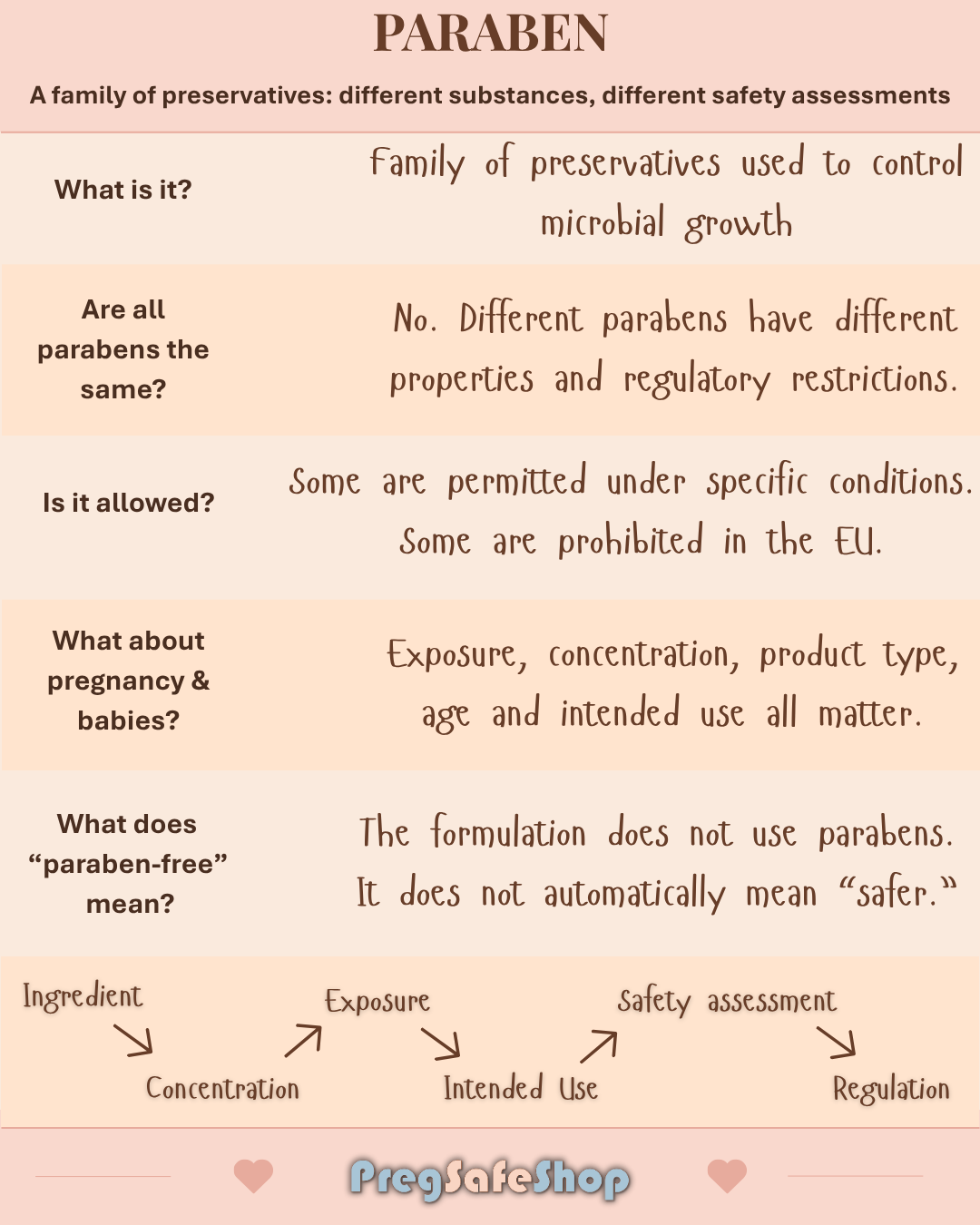
Parabens are a family of chemical compounds that are mainly used as preservatives in cosmetic products. They have been used for many decades and can be found in a wide range of products, including moisturizers, makeup and hair-care products, where protection against microbial growth is important. [1][2]
The word “parabens” does not refer to one specific substance. Instead, it describes a group of chemically related compounds derived from 4-hydroxybenzoic acid (PHBA). Different parabens are formed by combining this basic structure with different alcohol groups, resulting in substances with slightly different chemical structures and properties. [2]
The parabens most commonly encountered in cosmetic ingredient lists are:
- Methylparaben
- Ethylparaben
- Propylparaben
- Butylparaben
Although they belong to the same chemical family, these substances are not identical. Their chemical structures differ slightly, which is one reason why individual parabens can have different properties and are assessed separately for safety.
A simple way to think about it
Think of “parabens” as the surname of a family.
Methylparaben, ethylparaben, propylparaben and butylparaben are individual members of that family. They are related, but they are not the same substance.
Did you know?
“Paraben-free” does not mean “preservative-free.”
Many cosmetics need protection against bacteria, yeasts and moulds. When parabens are not used, manufacturers may use other preservatives or preservation strategies instead.
So when you see “paraben-free”, it tells you what is not in the product — but not necessarily how the product is preserved.
How Are Parabens Made?
Although the word “paraben” may sound like the name of a naturally occurring ingredient, parabens used in cosmetics are manufactured chemical compounds.
Chemically, parabens are esters of 4-hydroxybenzoic acid (PHBA). Different types of parabens are produced by combining this basic chemical structure with different alcohols. This produces compounds such as methylparaben, ethylparaben, propylparaben and butylparaben. [2]
In simple terms, the process can be thought of like this:
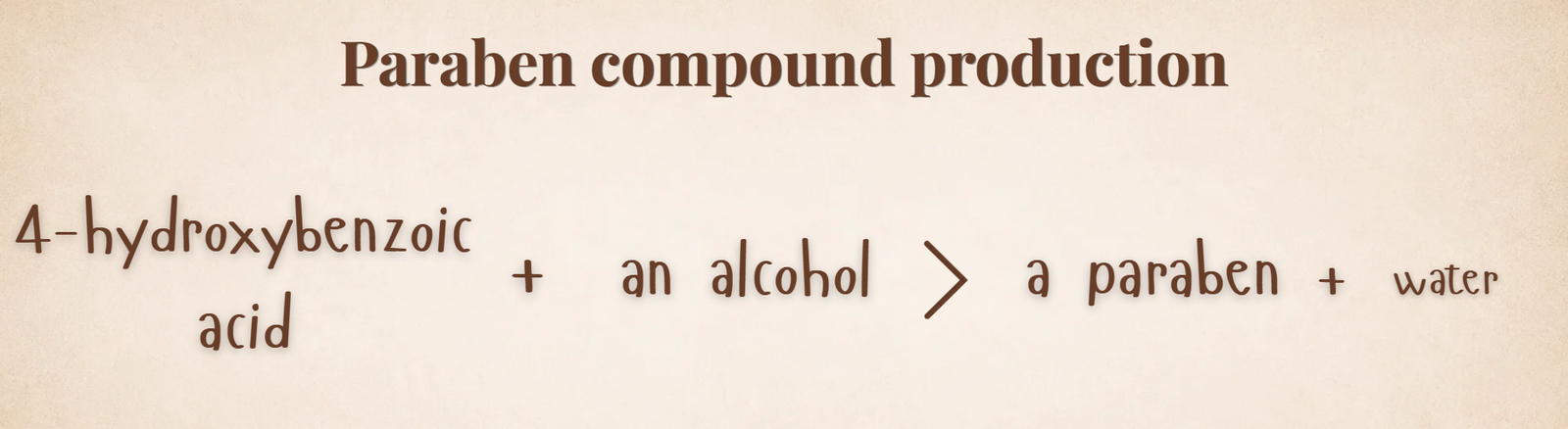
For example:
- Methanol → methylparaben
- Ethanol → ethylparaben
- Propanol → propylparaben
- Butanol → butylparaben
The manufacturing process is based on a chemical reaction called esterification. In industrial production, 4-hydroxybenzoic acid is reacted with the appropriate alcohol, typically using an acid catalyst. The resulting paraben is then purified and processed into the final material used by manufacturers. [2]
Does “chemical” mean “unsafe”?
Not necessarily.
The fact that a substance is manufactured or has a chemical name tells us very little by itself about whether it is safe or unsafe. Everything in a cosmetic product is made up of chemicals, including ingredients derived from plants or other natural sources.
What matters for safety is the specific substance, its properties, the amount used, how people are exposed to it, and the available toxicological evidence.
Why Are Parabens Used in Cosmetics?
The main reason parabens are used in cosmetics is simple: they are preservatives.
Many cosmetic products contain water, and water-based formulations can provide an environment in which microorganisms such as bacteria, yeasts and moulds can grow. Raw materials, manufacturing processes, packaging and even normal use can introduce microorganisms into a product. [6][7]
A preservation system helps control this microbial growth and protects the product throughout its intended period of use. This is not only about keeping a cream or lotion looking and smelling as it should. Microbial contamination can also make a cosmetic product unsafe for the person using it. [7]
How do parabens work?
Parabens work by interfering with essential functions of microorganisms.
In simple terms, parabens can interact with the cell membranes of bacteria, yeasts and moulds. This can disturb normal membrane function and interfere with processes that microorganisms need to survive and reproduce. Parabens can also affect other cellular processes involved in metabolism. [3]
This stops microorganisms from multiplying. At target concentrations, it can destroy them entirely.
So, in simplified form:
Paraben → interacts with the microorganism → disrupts essential cellular functions → microbial growth is inhibited
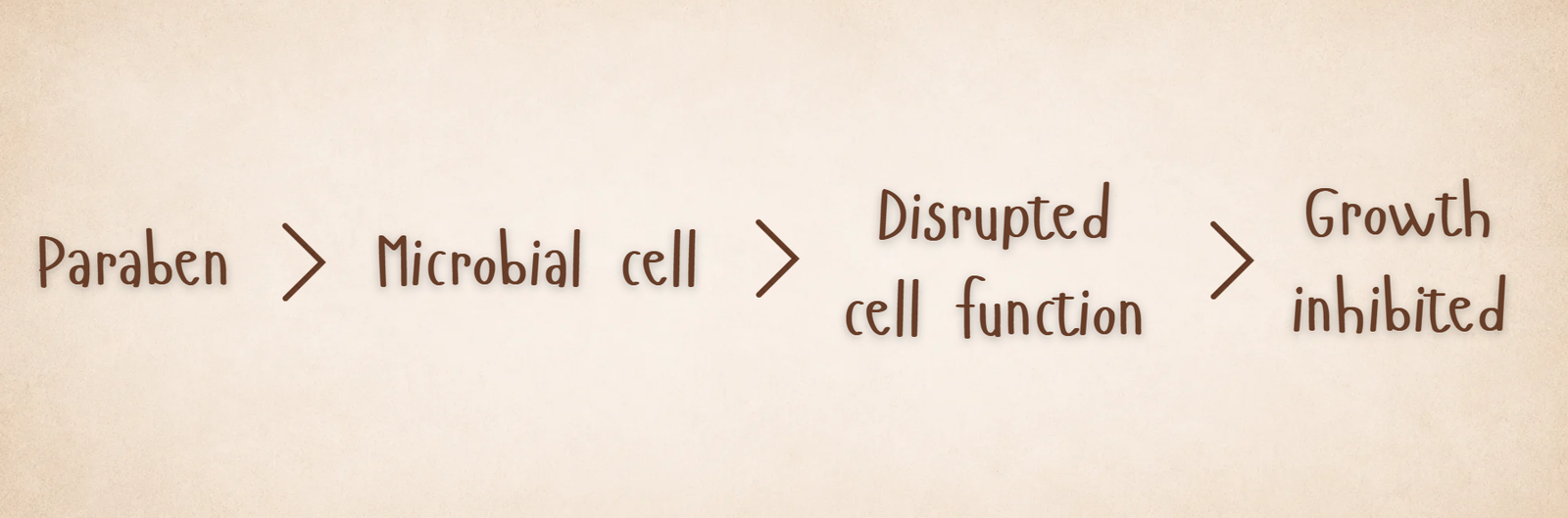
This is why parabens can help keep a cosmetic product microbiologically stable during its intended use.
It is more useful to think of parabens as antimicrobial substances: at effective concentrations, they can inhibit the growth of microorganisms. Their antimicrobial effect comes from specific interactions with microbial cells, and the concentration used in a cosmetic is important. [3]
Why is this useful in a cosmetic?
Imagine a body lotion containing water, oils and other ingredients. Without adequate protection, bacteria or fungi introduced during manufacturing or everyday use could multiply inside the product.
An effective preservation system helps prevent this from happening.
Parabens have been used for many decades because they can inhibit the growth of fungi and bacteria. Different parabens can also be used together, or as part of a broader preservation system, to provide suitable protection for a particular formulation. [8]
Preservation is part of product safety
It can be tempting to think of preservatives as something that is added to a cosmetic simply to make it last longer.
In reality, preservation can be an important part of cosmetic safety.
The choice of preservative, its concentration, the formulation, the packaging and the way the product is expected to be used can all contribute to its microbiological protection. Manufacturers therefore need to ensure that their products remain adequately protected against microbial contamination throughout their intended use. [6][7]
Does every cosmetic need a preservative?
Not necessarily.
Some products are formulated in ways that make microbial growth less likely — for example, because they contain little or no available water, or because their formulation and packaging provide other forms of protection.
But for many water-containing cosmetics, some form of preservation is needed to control microbial growth.
This is an important distinction when we later look at products labelled “paraben-free”. Removing parabens does not remove the need to consider microbiological safety. Instead, the manufacturer needs to use another suitable preservation strategy — or formulate the product in a way that provides adequate protection by other means.
In other words:
“paraben-free” does not mean “preservative-free”.
Why Did Parabens Become Controversial?
Parabens have been used as cosmetic preservatives for decades. So why did they become such a widely debated group of cosmetic ingredients?
The controversy developed as researchers began asking questions about how some parabens might interact with the human body, particularly the endocrine system, and whether repeated or long-term exposure could have effects beyond their intended preservative function.
Several areas of research have contributed to the debate.
The concern about hormone-like activity
One of the main reasons parabens attracted scientific attention is that some of them have been shown to have oestrogen-like activity.
Oestrogen is a naturally occurring hormone involved in many functions in the body. Certain chemicals can interact with hormone-related pathways and produce effects that resemble, or interfere with, the action of natural hormones. This is known as endocrine activity.
Studies have shown that some parabens can interact with hormone receptors and other endocrine pathways. However, the strength of these effects varies considerably between different parabens, and their oestrogenic activity is generally much weaker than that of natural oestrogen. [4][5]
This distinction is important.
But interaction doesn’t equal harm. A chemical must be present in a high enough concentration to trigger a harmful effect.
That is where toxicological risk assessment becomes important.
Questions about reproduction and development
Once endocrine activity became a focus of research, scientists also began investigating whether paraben exposure could affect reproductive health and development.
Studies in laboratory animals and epidemiological studies in humans have investigated possible effects on reproductive hormones, fertility, pregnancy, birth outcomes and pubertal development.
Some studies have reported effects, but the overall evidence is limited and sometimes inconsistent. A 2024 review of epidemiological and rodent studies concluded that further research is needed, particularly using exposure levels relevant to humans, considering mixtures of parabens and looking at longer-term exposure. [9]
This is an important distinction: these studies raise legitimate scientific questions, but they do not establish that normal cosmetic exposure to parabens causes infertility, pregnancy complications or developmental problems.
What about breast cancer?
Another part of the controversy concerns the possibility of a relationship between parabens and breast cancer.
A study published in 2004 reported detecting parabens in samples of human breast tumour tissue. The finding attracted considerable attention because it demonstrated that parabens could be detected in human breast tissue and raised questions about their possible biological relevance. [10]
However, detecting a chemical in tissue does not demonstrate that the chemical caused the disease.
The study was small and did not establish that parabens cause breast cancer. Subsequent research has continued to investigate the possible relationship between paraben exposure and breast cancer, but reviews have concluded that the evidence linking the two remains limited. [10]
So this is another example where an observation can be scientifically interesting and worthy of further investigation without proving a health effect.
Repeated and combined exposure
Another question is how much exposure people receive over time.
A person may not encounter parabens through a single cosmetic product. Depending on the products they use, exposure can potentially come from several cosmetics and personal-care products, as well as from other sources.
This makes exposure assessment more complicated.
For children in particular, exposure may need to be considered in relation to body weight and the use of several products during the same period.
There are also environmental questions
Parabens have also been investigated from an environmental perspective because they can enter wastewater and have been detected in environmental samples.
However, this is a separate question from human health safety. The SCCS specifically states that environmental aspects are outside its mandate, so its cosmetic safety assessments do not assess whether a paraben is environmentally safe. [4][5]
For that reason, environmental concerns are worth acknowledging, but they should not be confused with the human-health risk assessments discussed in this article.
So, why did parabens become controversial?
The controversy is therefore not based on one single finding.
It developed from a combination of:
- evidence that some parabens have endocrine activity;
- research investigating possible effects on reproduction and development;
- questions about long-term and repeated exposure;
- concerns about exposure from multiple products and combinations of substances;
- research investigating possible links with breast cancer;
- and, separately, questions about their environmental presence and effects.
At the same time, these concerns do not mean that all parabens have the same hazard profile, or that exposure to a cosmetic containing a permitted paraben automatically represents a health risk.
Are All Parabens the Same?
Not all parabens are the same.
Although methylparaben, ethylparaben, propylparaben and butylparaben belong to the same chemical family, their structures differ slightly. These differences can influence how they behave in the body and how their safety is assessed.
This is particularly important because cosmetic regulations do not simply treat “parabens” as one single substance. Different parabens have been evaluated individually, and some are subject to different concentration limits or restrictions. [4][5]
Methylparaben and ethylparaben
Methylparaben and ethylparaben are among the most widely used parabens.
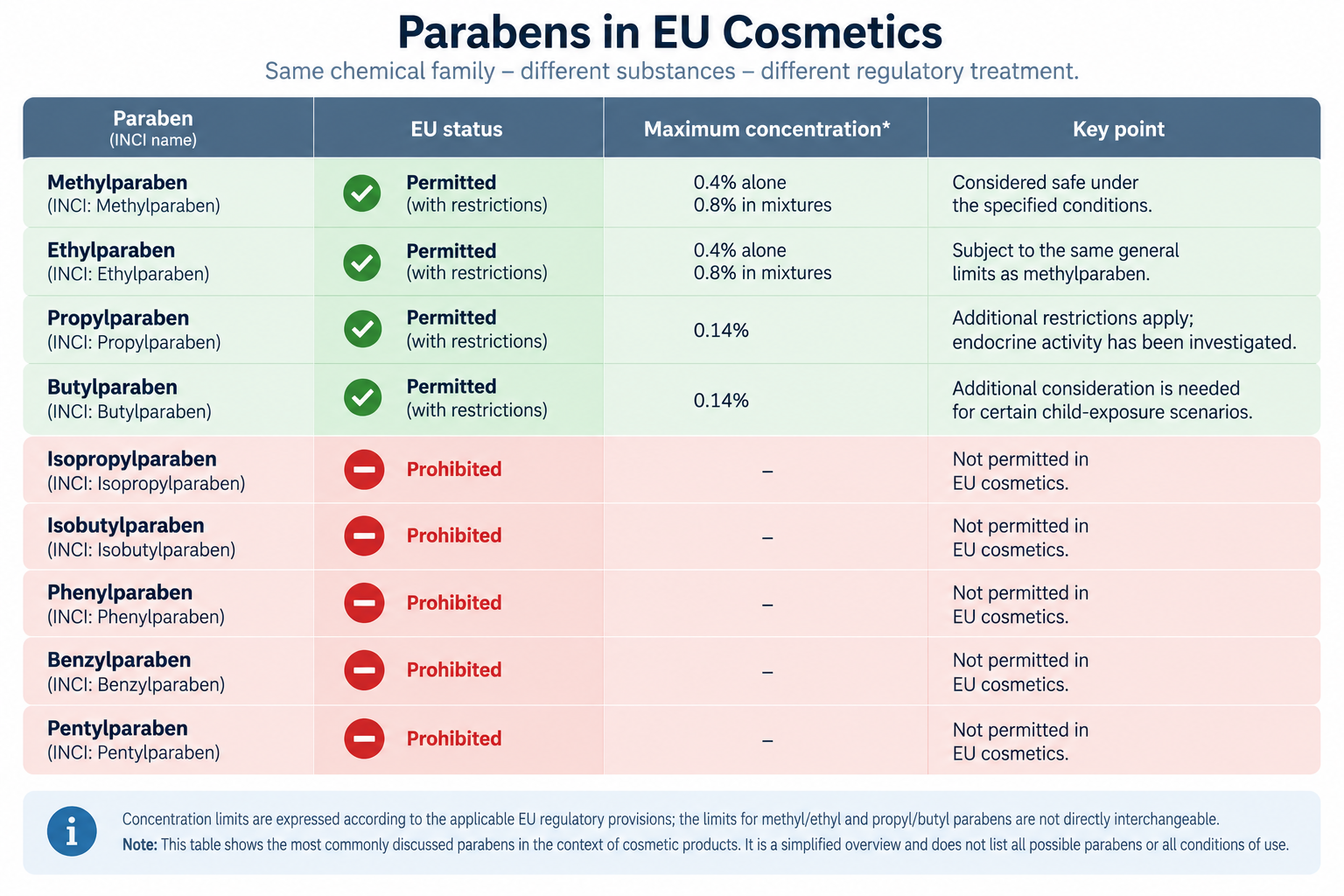
The Scientific Committee on Consumer Safety (SCCS) has assessed methylparaben and concluded that it can be considered safe as a preservative in cosmetic products at concentrations of up to 0.4%, expressed as the acid, when used alone. When several parabens covered by the relevant regulation are used together, the total concentration is subject to an overall limit of 0.8%, expressed as the acid. [4]
Ethylparaben is subject to the same general maximum concentration limits under the EU Cosmetics Regulation. [12]
Propylparaben and butylparaben
Propylparaben and butylparaben are structurally similar to methyl- and ethylparaben, but their longer chemical groups give them somewhat different properties.
The SCCS has assessed both substances in relation to their use as cosmetic preservatives.
For propylparaben, the SCCS concluded that it can be considered safe as a preservative at a maximum concentration of 0.14%. The assessment also discussed indications of possible endocrine effects, but concluded that the available evidence was insufficient to regard propylparaben as an endocrine-disrupting substance for the purposes of human-health risk assessment. [5]
For butylparaben, the SCCS similarly concluded that it can be considered safe as a preservative at concentrations up to 0.14% under the conditions assessed. [16] However, the assessment also highlighted that safety for certain child exposure scenarios required particular consideration. [11]
This illustrates an important principle:
Belonging to the same chemical family does not mean that substances have identical safety profiles.
Some parabens are not permitted in EU cosmetics
There are also parabens that are prohibited in cosmetic products in the European Union.
These include:
- Isopropylparaben
- Isobutylparaben
- Phenylparaben
- Benzylparaben
- Pentylparaben
These substances were removed from the list of permitted preservatives following the EU’s regulatory assessment. [14]
So when we talk about “parabens”, it is important not to treat the entire group as though it were one substance with one universal safety conclusion.
Why does the difference matter?
This is one of the reasons that simply saying “parabens are safe” or “parabens are unsafe” is too simplistic.
A proper safety assessment considers the specific substance, its concentration, the type of cosmetic product, how it is used, and the likely exposure of the consumer.
For example, a preservative concentration that may be considered safe for one paraben cannot automatically be transferred to another paraben. Likewise, an assessment for adults cannot necessarily be assumed to apply in exactly the same way to infants or young children, whose exposure can be different relative to their body weight and who may use products in different ways. [11]
This is why European safety assessments are performed for individual substances and specific exposure scenarios, rather than simply for the word “parabens”.
One more important distinction: SCCS opinion vs. EU law
You may notice that we refer to both SCCS safety assessments and EU regulations.
They are related, but they are not the same thing.
The Scientific Committee on Consumer Safety (SCCS) provides scientific opinions on the safety of cosmetic ingredients. These opinions form an important part of the scientific basis for regulatory decisions.
The EU Cosmetics Regulation, on the other hand, establishes the legally applicable rules — including which substances are prohibited or restricted and the conditions under which certain preservatives may be used. [12]
This distinction becomes particularly important when scientific knowledge develops or new exposure scenarios are assessed. A new SCCS opinion does not automatically mean that the legal wording or concentration limit in the Cosmetics Regulation has changed.
What should consumers take from this?
The most useful takeaway is simple:
“Parabens” is a chemical family, not a single ingredient.
Methylparaben, ethylparaben, propylparaben and butylparaben are different substances, with different scientific assessments and, in some cases, different regulatory conditions.
That is why it is more useful to look at the specific ingredient in the INCI list than to make a judgement based only on the word “parabens”.
The Danish Approach
As we have seen in the previous section, EU regulations set specific rules for parabens in cosmetics. Some parabens are prohibited, while others are permitted only under defined conditions and concentration limits.
Denmark has taken an additional precautionary approach when it comes to cosmetics intended for young children.
In Denmark, propylparaben and butylparaben, as well as isopropylparaben and isobutylparaben, are prohibited in cosmetic products intended for children under 3 years of age. [8][13]
This goes beyond the corresponding EU restriction, which specifically addresses the use of certain parabens in products intended for application to the nappy area of children under 3. [15]
What does this mean for parents?
For parents in Denmark, this creates an important practical distinction.
A cosmetic product containing propylparaben or butylparaben, for example, may be permitted under the general EU rules when used within the applicable conditions. However, the same ingredients are not permitted in cosmetics intended for children under 3 in Denmark. [8][13]
This is why checking only whether an ingredient is permitted under EU rules may not always give the complete picture for a Danish consumer.
When choosing cosmetics for babies and young children, it is therefore relevant to consider the specific ingredient, its concentration, the intended use of the product, and the applicable Danish requirements.
What About Pregnancy and Babies?
Pregnancy is a period when many people become more conscious of the substances they are exposed to. This naturally raises questions about cosmetic ingredients such as parabens.
Parabens are relevant in this context because they can be absorbed through the skin and have been detected in biological samples from pregnant women. [17]
However, detecting a substance in the body does not by itself mean that it causes harm. To assess a potential health risk, scientists need to consider the specific substance, the amount and duration of exposure, how it enters the body, and the available evidence for an effect.
Can parabens be detected during pregnancy?
Yes.
Studies have shown that parabens can be detected in pregnant women. In one study involving 99 pregnant women, parabens were detected in both maternal urine and amniotic fluid. The researchers did not find statistically significant associations between the detected paraben levels and the newborns’ physical measurements or health characteristics. [17]
This illustrates an important distinction:
Exposure and harm are not the same thing.
Finding a chemical in a biological sample demonstrates that exposure has occurred. It does not establish that the exposure has caused an adverse health effect.
What about pregnancy and birth outcomes?
Researchers have also investigated whether exposure to parabens during pregnancy may be associated with outcomes such as fetal growth and birth size.
A study from the Odense Child Cohort in Denmark, involving 529 mother–child pairs, found that higher maternal exposure to n-butylparaben was associated with lower birth size in female offspring. No similar association was observed for the other parabens examined. [18]
However, this was an observational study. An association between an exposure and an outcome does not demonstrate that the exposure caused the outcome. Other factors may contribute to an observed relationship, and a single study cannot establish a causal effect.
Other research has also produced mixed results. Some studies have reported associations between prenatal paraben exposure and aspects of fetal or child development, while others have not found clear relationships. [9][18]
The scientific evidence therefore does not provide a simple conclusion that parabens are either harmful or harmless during pregnancy.
Does this mean parabens should be avoided during pregnancy?
Not necessarily.
The fact that researchers are investigating possible effects does not mean that the use of a cosmetic containing a permitted paraben has been shown to be harmful during pregnancy.
At the same time, pregnancy is a period in which some consumers may reasonably prefer to minimise unnecessary exposure to ingredients that are the subject of ongoing scientific discussion.
This is where the distinction between regulatory safety and personal product choice becomes important.
Cosmetic ingredients that are permitted under the applicable regulations have undergone safety assessment based on their intended conditions of use. Choosing a product without a particular ingredient, however, can still be a personal preference — especially when suitable alternatives are available.
What about babies and young children?
Babies and young children deserve particular consideration when thinking about cosmetic exposure.
Their lower body weight, developing physiology and patterns of product use can influence exposure. A product used over a large area of a baby’s skin, or several products used regularly, can result in a different exposure scenario from that of an adult using a small amount of one product.
This is one reason why age and intended use are important parts of cosmetic safety assessment.
The EU has introduced specific restrictions for certain parabens in leave-on products intended for the nappy area of children under 3, and Denmark has additional national restrictions for certain parabens in cosmetics intended for this age group. As we saw in the previous sections, these rules reflect the importance of considering exposure in young children. [15][8][13]
So what should parents take from this?
There are two important messages.
First, the available evidence does not justify treating all parabens as equally harmful during pregnancy or childhood. Different parabens have different properties and have been assessed individually.
Second, “permitted” does not mean that every possible exposure scenario is identical. The specific ingredient, concentration, product type, frequency of use, age of the user and overall exposure all matter.
For parents and expectant parents, this means that there is no need to interpret the word “paraben” as an automatic indication of danger. But it is also reasonable to look beyond a simple “allowed/not allowed” distinction and consider the overall formulation and intended use of a cosmetic product.
Why Do Brands Advertise “Paraben-Free”?
If parabens are regulated and some are permitted for use in cosmetics, why do so many products proudly advertise themselves as “paraben-free”?
The answer is not necessarily that the product would otherwise be unsafe.
Consumer expectations
Over the years, parabens have become associated in the public mind with concerns about hormones, long-term exposure and cosmetic safety. As a result, some consumers actively look for products without parabens.
For brands, a “paraben-free” claim can therefore communicate that the product fits a particular consumer preference — especially among people who are looking for simpler formulations or who want to avoid ingredients that have attracted controversy.
This can be particularly common in products marketed for babies, sensitive skin and pregnancy, where consumers may be more cautious about ingredient choices.
“Free-from” claims can be powerful marketing
“Paraben-free” is also an example of a broader “free-from” approach to cosmetic marketing.
Instead of telling consumers what a product contains, the claim highlights what it does not contain.
This can make a product appear more reassuring or more carefully formulated, even though the absence of one ingredient does not, by itself, tell us how the rest of the formulation has been designed.
For example, a product can be paraben-free, but still contain other preservatives.
The claim therefore needs to be understood in context.
Why might a brand choose not to use parabens?
There are also perfectly practical formulation reasons.
A manufacturer may decide that another preservation system is more suitable for a particular formulation, packaging system or target consumer group. A brand may also formulate without parabens simply because its customers prefer it.
In other words, a product does not need to contain parabens simply because parabens are effective preservatives.
The important point is that choosing a different preservative system does not automatically make a product safer. The alternative preservation system also needs to be suitable for the formulation and safe under its intended conditions of use.
So what does “paraben-free” actually tell you?
At its most basic level, “paraben-free” tells you that the manufacturer is presenting the product as being formulated without parabens.
It may therefore be useful information if you specifically want to avoid parabens.
But it does not tell you:
- which preservatives are used instead;
- whether the product is suitable for sensitive skin;
- whether it is better for pregnancy or babies;
- whether the overall formulation has a lower health risk;
- or whether the product is more microbiologically safe.
Those are separate questions.
And that brings us to an important distinction:
“Paraben-free” describes the absence of a particular ingredient group. It does not, on its own, describe the overall safety of a cosmetic product.
Does “Paraben-Free” Mean Safer?
It is easy to assume that if a product does not contain parabens, it must therefore be safer.
But “paraben-free” does not automatically mean “safer.”
The reason is simple: removing one preservative does not tell us what has been used instead, or whether the overall formulation is better suited to the person using it.
A different preservative is still a preservative
If a water-containing cosmetic needs protection against microbial growth, removing parabens does not remove that need.
A manufacturer may replace parabens with another preservative, use a combination of preservatives, or use a different preservation strategy altogether.
Each approach has its own safety considerations.
For example, some alternative preservatives have their own restrictions or have been the subject of safety assessments because of concerns such as skin sensitisation, irritation or other toxicological effects.
This is why it would be misleading to think of cosmetic preservatives as simply falling into two categories:
“parabens = bad”
“anything else = good”
The reality is much more complicated.
Safety depends on the whole formulation
When assessing the safety of a cosmetic product, the relevant question is not simply:
Does it contain parabens?
Instead, we need to consider the complete formulation and the conditions under which the product is used.
This includes factors such as:
- which ingredients are present;
- their concentrations;
- how the product is applied;
- how often it is used;
- how much of the product is used;
- whether it is rinsed off or left on the skin;
- who is using it;
- and the expected overall exposure.
This is the same principle we have seen throughout this series: an ingredient cannot be judged meaningfully by its name alone.
“Paraben-free” can still be a valid choice
None of this means that choosing a paraben-free product is an unreasonable choice.
If you prefer to avoid parabens, a paraben-free product can be a perfectly reasonable personal choice — particularly when there are several suitable products available.
The important distinction is between saying:
“I prefer products without parabens.”
and saying:
“Products without parabens are safer.”
The first is a product preference.
The second is a much broader safety claim, and it cannot be established simply from the absence of parabens.
What about other preservatives?
This is where the ingredient list becomes important.
Two products may both be labelled “paraben-free”, while using completely different preservation systems.
One might use a combination of preservatives with a long history of use and well-established safety limits. Another might use different ingredients with their own restrictions or potential for irritation or sensitisation.
For example, the EU Scientific Committee on Consumer Safety has assessed preservatives such as phenoxyethanol and methylisothiazolinone (MI) under specific conditions. Their assessments illustrate an important point: preservatives need to be evaluated individually and according to how they are used, rather than simply classified as safe or unsafe as a group. [19][20]
A paraben-free product may be a good product. A product containing a permitted paraben may also be a safe product when used under the conditions for which it has been assessed.
The absence of parabens is therefore one piece of information — not a complete safety assessment.
And this is why, when choosing cosmetics for pregnancy, babies or sensitive skin, it can be more useful to look at the whole formulation and intended use rather than relying on a single “free-from” claim.
How Can You Recognize Parabens in an INCI List?
What names should you look for?
Parabens are generally easy to identify in an ingredient list because their names typically contain the word “paraben.”
The most common ones are:
- Methylparaben
- Ethylparaben
- Propylparaben
- Butylparaben
If you see one of these names in the INCI list, the product contains a paraben.
There are also other paraben names that you may encounter in ingredient databases or regulatory information, including isopropylparaben, isobutylparaben, phenylparaben, benzylparaben and pentylparaben. These substances are prohibited in EU cosmetics. [14]
If you spot any of these ingredients in the INCI list of a cosmetic marketed in the EU, it is worth taking a closer look. Their presence could indicate that the product does not meet the applicable EU requirements, that the ingredient information is incorrect, or that the product was originally formulated for another market.
What about combinations?
A cosmetic can contain more than one paraben.
For example, an ingredient list might contain both methylparaben and propylparaben. This does not mean that the product is necessarily unsafe. The relevant question is whether the individual ingredients are being used within the applicable regulatory conditions and concentration limits.
This is another reason why simply counting the number of parabens in an ingredient list does not tell you whether a product is safe.
Where do you find them?
Cosmetic ingredients are listed on the packaging using their standardized ingredient names, commonly referred to as the INCI names. [21]
The ingredient list is usually found on the product packaging or container, often under a heading such as “Ingredients.”
You do not need to understand every chemical name on the label to identify parabens.
For the purpose of this article, a simple rule is often enough:
If the ingredient name ends in “-paraben”, it is a paraben.
A useful distinction
It is also important not to confuse parabens with other preservatives.
Ingredients such as phenoxyethanol, benzoic acid or sorbic acid are preservatives, but they are not parabens.
So if your personal preference is to choose a paraben-free product, you do not need to avoid every preservative. You are specifically looking for the paraben ingredients.
A quick label check
If you want to check a cosmetic yourself, you can use this simple three-step approach:
1. Find the ingredient list
Look for the section labelled “Ingredients”.
2. Scan for names containing “paraben”
Pay particular attention to methylparaben, ethylparaben, propylparaben and butylparaben.
3. Remember what the list does — and does not — tell you
The presence of a paraben tells you that the ingredient is part of the formulation. It does not, by itself, tell you whether the product is safe or unsafe.
🌸 How We Think at PregSafeShop
At PregSafeShop, we follow both the scientific and regulatory developments surrounding cosmetic ingredients, while also being aware of the concerns and preferences that influence today’s market.
Our current products do not use parabens as preservatives. The products we select come from manufacturers with a dedicated focus on pregnancy, babies and young families, and choosing not to use parabens is part of the formulation choices these manufacturers have made for their products.
But there is an important message we want to make clear:
Seeing the word “paraben” in a cosmetic ingredient list should not, by itself, be a reason for alarm.
As we have seen throughout this article, cosmetic ingredients do not simply appear on the market without scrutiny. There is an established framework of product safety assessment, scientific review and regulatory requirements that determines which cosmetic ingredients may be used, under which conditions and at which concentrations. [4][5][12]
These assessments and regulations also evolve as scientific knowledge develops.
So, while we may choose products without parabens for our own selection, this should not be understood as saying that every cosmetic containing a permitted paraben is unsafe.
Instead, our aim with this series is to help consumers understand what is behind the ingredients they see on a label — and to make informed choices based on more than a single word such as “paraben” or “paraben-free.”
Because understanding the science behind an ingredient is a better starting point than being afraid of its name.
References
[1] U.S. Food and Drug Administration (FDA). Parabens in Cosmetics.
[2] Cherian, M. et al. Amended Safety Assessment of Parabens as Used in Cosmetics. 2020. Open-access.
[3] Antimicrobial Preservatives for Protein and Peptide Formulations: An Overview. Open-access review
[4] European Commission, SCCS. Methylparaben (CAS No. 99-76-3, EC No. 202-785-7). SCCS/1652/23.
[5] European Commission, SCCS. Propylparaben. SCCS/1623/20, final opinion 2021.
[6] U.S. Food and Drug Administration (FDA). Microbiological Safety and Cosmetics.
[7] U.S. Food and Drug Administration (FDA). Shelf Life and Expiration Dating of Cosmetics.
[8] Danish Environmental Protection Agency (Miljøstyrelsen). Faktaark om parabener i kosmetik.
[10] Minireview: Parabens Exposure and Breast Cancer. 2022. Open-access review.
[13] Danish Environmental Protection Agency (Miljøstyrelsen). Lovgivning om kosmetiske produkter.
[16] European Commission, SCCS. Butylparaben (CAS No. 94-26-8, EC No. 202-318-7). SCCS/1651/23.
[19] European Commission, SCCS. Methylisothiazolinone (MI) – P94 Submission III – Sensitisation only.
[20] European Commission, SCCS. Phenoxyethanol. SCCS/1575/16.
[21] European Commission. CosIng – Cosmetic Ingredient Database.
About the PregSafeShop Knowledge Series
The PregSafeShop Knowledge Series aims to explain cosmetic science in a clear, balanced and evidence-based way. Rather than telling readers what to think, our goal is to help parents understand how cosmetic products are developed, assessed and regulated, empowering them to make informed decisions with confidence.
Disclaimer. This article is part of the PregSafeShop Knowledge Series, created to provide evidence-based educational information about cosmetics, skincare and pregnancy. The information presented is intended for general educational purposes only and should not be considered a substitute for personalised medical advice, diagnosis or treatment. If you have specific questions about your health, pregnancy or your child’s wellbeing, please consult your doctor, midwife or another qualified healthcare professional. Scientific knowledge and cosmetic regulations continue to evolve. While we strive to keep our content accurate and up to date, recommendations and regulatory requirements may change as new evidence becomes available.