
The Journey of a Cosmetic Fragrance
What does “Parfum” mean on a cosmetic ingredient list? It is one of the most common questions asked by consumers.
For some people, it is simply the pleasant scent of a favourite cream or shampoo. For others, it raises concerns about allergies, skin irritation or the use of cosmetics during pregnancy.
Yet despite all the discussion, few people actually know what the word “Parfum” means from a scientific or regulatory perspective.
Is it a single ingredient?
Is it always synthetic?
Does it mean essential oils?
Can we judge the safety of a cosmetic product simply because it contains “Parfum”?
The answer to all of these questions is more nuanced than many people imagine.
In this chapter of the PregSafeShop Knowledge Series, we’ll explore what fragrance really is, why manufacturers use it, how it is regulated in the European Union [1], and what current scientific evidence tells us about its use during pregnancy and for babies.
Before discussing whether fragrance is appropriate for a particular person or product, it is important to understand what the word “Parfum” actually represents.
What Does “Parfum” Mean?
The first surprise is that “Parfum” is not a single ingredient.
When you see Parfum (or Fragrance) on a cosmetic ingredient list, it refers to a fragrance composition—a carefully developed blend of aromatic substances designed to give a cosmetic product its characteristic scent.
Some fragrance compositions are relatively simple, while others may contain dozens of individual aromatic substances working together to create a specific fragrance profile.
Depending on the desired scent and the product itself, a fragrance composition may include:
- naturally derived aromatic ingredients;
- synthetic aroma molecules;
- nature-identical ingredients;
- or a combination of these.
The exact formulation varies from product to product and is usually considered proprietary information developed by specialized fragrance experts. This is one of the reasons why the ingredient list simply states “Parfum” instead of listing every aromatic component individually.
Did you know?
Many people imagine that the scent of a cosmetic comes directly from the plant or fruit it reminds them of.
In reality, fragrances are often carefully designed compositions. A cream that smells like coconut, fresh cotton or vanilla does not necessarily contain coconut, cotton or vanilla extracts. The desired scent may instead be created by combining different aromatic substances that together reproduce that particular fragrance profile.
More Than Just a Pleasant Smell
Another common misconception is that fragrance is added to cosmetics simply because “people like nice smells.”
While consumer experience is certainly important, fragrance serves several purposes during product development.
A carefully designed fragrance can help mask the natural odour of raw materials such as vegetable oils, botanical extracts or proteins. It also contributes to the overall sensory experience of a product and can become part of a brand’s identity.
For products intended for daily use, a pleasant sensory experience may even encourage consistent use as part of a skincare routine. In other words, fragrance is not simply an optional perfume added at the end of production. It is often considered one element of the overall product design.
Fragrance Is an Entire Industry
One aspect that is rarely discussed is who actually develops the fragrances used in cosmetics.
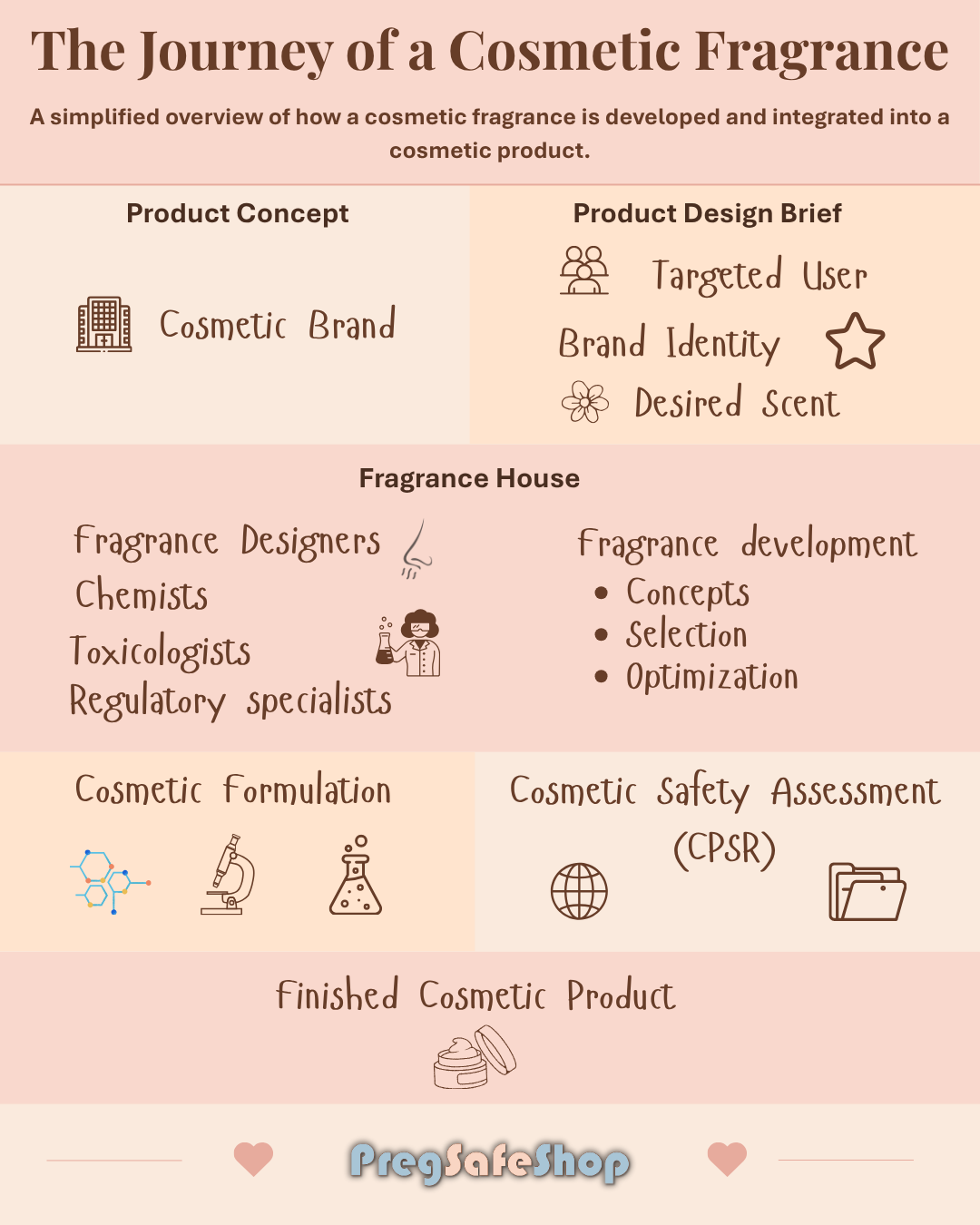
Many consumers imagine that cosmetic brands create their own fragrances from scratch. In reality, many brands collaborate with specialized fragrance houses—companies whose expertise is developing fragrance compositions for cosmetics, personal care products and perfumes. One example is the Swiss company Givaudan, founded in 1768[5] and today one of the world’s leading fragrance and flavor companies. Another is dsm-firmenich, a global company combining fragrance creation with expertise in biotechnology, health and beauty[6]. These companies employ perfumers, chemists, toxicologists, formulation scientists and regulatory specialists who work together to develop fragrances that are pleasant, stable and compliant with international safety standards.
Developing a fragrance is therefore much more than choosing a pleasant smell. It is a multidisciplinary process that combines chemistry, toxicology, sensory science and regulatory expertise. Understanding this broader picture helps explain why the word “Parfum” represents far more than simply “adding perfume” to a cosmetic product.
The process can be simplified as shown below.
🌸 How We Think at PregSafeShop
At PregSafeShop, one of the goals of this Knowledge Series is to replace assumptions with understanding.
When we see the word “Parfum” on an ingredient list, we don’t immediately conclude that a product is either “good” or “bad.”
Instead, we ask better questions.
- What role does the fragrance play in this product?
- Who is the product intended for?
- What information has the manufacturer made available?
- What does the current scientific evidence tell us?
As we learned in Chapter 1, cosmetic safety is assessed based on the finished product—not on the presence of a single ingredient in isolation.
For that reason, we believe that the word “Parfum” should be the beginning of the conversation, not the end of it.
How Is Fragrance Regulated in the European Union?
Most people are surprised to learn that fragrances used in cosmetics are not simply chosen because they smell pleasant.
Before a cosmetic product containing fragrance can be placed on the European Union market, it must comply with a combination of scientific, regulatory and industry requirements designed to protect consumer health.
This is important because the word “Parfum” on an ingredient list represents far more than a pleasant scent. Behind that single word lies a structured framework involving toxicological assessment, ingredient restrictions, labelling requirements and ongoing scientific review.
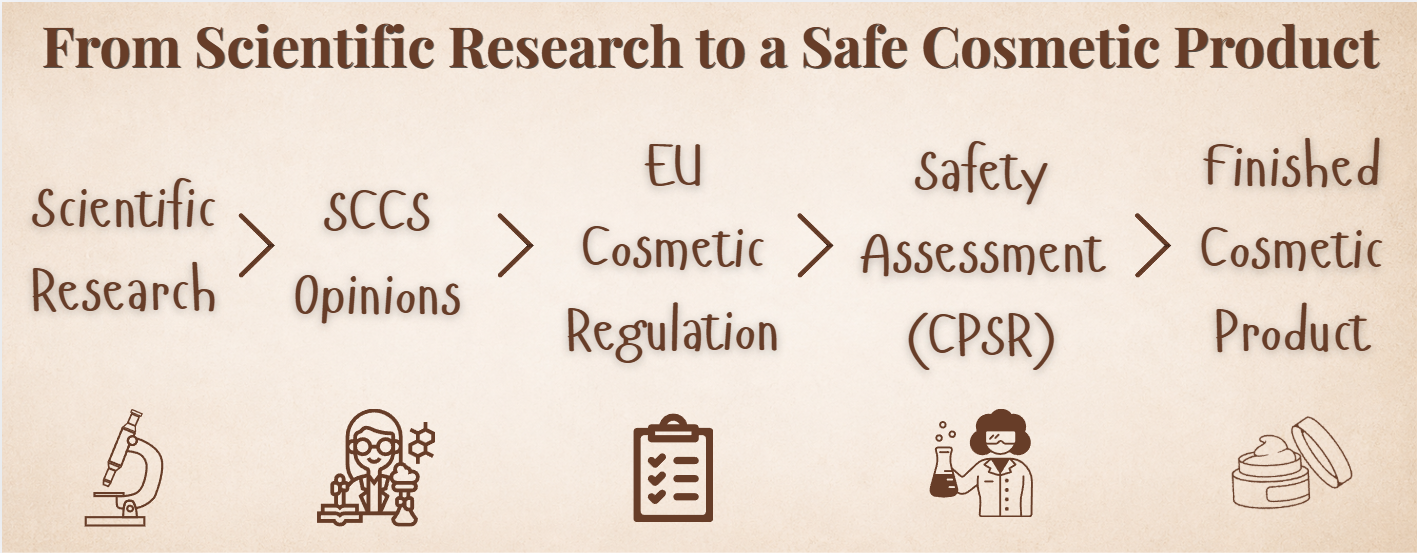
As we learned in Chapter 1, cosmetic safety in the European Union is based on evaluating the finished product rather than approving individual ingredients in isolation. Fragrances are no exception. They form part of the overall Cosmetic Product Safety Report (CPSR)[1], where their contribution to the safety of the finished formulation is assessed.
📖 Related reading: Chapter 1 – How Is the Safety of Cosmetics Ensured Before They Reach the Market?
How Safety Is Evaluated
The safety of cosmetic products in the European Union—including those containing fragrance—is governed by Regulation (EC) No. 1223/2009[1], one of the world’s most comprehensive legal frameworks for cosmetic products.
Before a cosmetic product can be placed on the European market, the regulation requires that it undergoes a scientific safety assessment to demonstrate that it is safe for its intended use. These requirements apply equally to products containing fragrance and to fragrance-free products.
Among other things, the regulation requires that cosmetic products:
- are safe for their intended use;
- undergo a scientific safety assessment before being marketed;
- contain only ingredients permitted under European legislation;
- comply with labelling requirements; and
- remain subject to market surveillance after reaching consumers.
Fragrance ingredients are therefore not exempt from this regulatory process simply because they appear on the ingredient list as “Parfum.”
The Scientific Assessment
A common misconception is that once a fragrance has been created, it is simply added to a cosmetic formulation.
In reality, every fragrance composition must be considered as part of the scientific assessment of the finished cosmetic product.
The safety assessor evaluates factors such as:
- the concentration of the fragrance in the formulation;
- the intended use of the product;
- how often it is expected to be used;
- the area of the body where it will be applied;
- the expected level of consumer exposure;
- and the target population.
These principles apply to all cosmetic products, including those intended for pregnant women, babies and young children. When a product is specifically developed for these groups, the intended users form part of the overall scientific safety assessment, together with the product’s formulation and expected conditions of use.
This is one of the reasons why the same fragrance composition may be considered suitable in one product but not in another.
For example, a fragrance used in a rinse-off baby shampoo will be assessed differently from the same fragrance used in a leave-on body lotion. Although the fragrance composition may be identical, the expected consumer exposure is different, and this difference in consumer exposure is one of the factors considered during the Cosmetic Product Safety Assessment.
Ultimately, this illustrates an important principle introduced in Chapter 1: cosmetic safety cannot be determined by looking at a single ingredient in isolation. It depends on the complete formulation, its intended use and the expected consumer exposure.
Did you know?
The presence of the word “Parfum” on an ingredient list does not automatically tell us how much fragrance is present in the product.
Some cosmetic products contain only a very small amount of fragrance, while others use higher concentrations depending on their intended purpose. The fragrance concentration is just one of many factors considered during the scientific safety assessment of the finished cosmetic product.
Fragrance Allergens
Although the exact fragrance composition is usually protected as proprietary information, European legislation also recognizes the importance of informing consumers about ingredients that are known to cause allergic reactions in susceptible individuals.
For this reason, certain fragrance allergens must be declared individually on the ingredient list when their concentration exceeds specific regulatory thresholds[2].
This allows consumers with known fragrance allergies to identify ingredients that may be relevant for them, while still protecting the confidential formulation developed by the fragrance house.
It is therefore common to see an ingredient list that contains:
Parfum, Linalool, Limonene, Citral…
This does not mean these ingredients were added separately.
In many cases, these substances are naturally present within the fragrance composition itself rather than being added separately to the cosmetic product.
Science Continues to Evolve
One of the strengths of the European regulatory system is that it is not static.
Scientific committees such as the Scientific Committee on Consumer Safety (SCCS)[3][4] continuously review new evidence on cosmetic ingredients, including fragrance substances. When appropriate, their scientific opinions support updates to cosmetic legislation and safety guidance.
Not every new scientific study leads to a regulatory change. Instead, the available evidence is carefully evaluated before regulatory decisions are made.
This continuous review process helps ensure that cosmetic safety requirements remain aligned with the best available scientific knowledge.
🌸 How We Think at PregSafeShop
Fragrance is only one part of a cosmetic formulation. Rather than asking whether a product simply contains “Parfum”, we believe it is more meaningful to ask:
- Has the finished product undergone a scientific safety assessment (CPSR)?
- Does it comply with European cosmetic regulations?
- Is the product appropriate for its intended use?
- Does the manufacturer demonstrate transparency and a responsible approach to product development?
These are the questions that guide how we evaluate the brands and products we choose to offer at PregSafeShop.
Summary
Although the word “Parfum” may appear as a single ingredient on a cosmetic label, it represents a carefully developed fragrance composition that forms part of the overall cosmetic formulation. Like every other component of a cosmetic product, fragrance is evaluated as part of the scientific safety assessment required before products are placed on the European market.
Understanding what “Parfum” really means helps us move beyond assumptions and appreciate how cosmetic safety is assessed based on the finished product, its intended use and the available scientific evidence.
Coming Next
In the next chapter of the PregSafeShop Knowledge Series, we’ll explore one of the most misunderstood topics in skincare: sun protection.
What is the difference between UVA and UVB rays? How does SPF really work? What are UV filters, and how are they scientifically evaluated before being used in cosmetic products? We’ll also explain the difference between mineral and organic UV filters, and what current scientific evidence tells us about their use in products intended for pregnant women and babies.
If you’re looking for practical tips to protect your skin during the warmer months, you may also enjoy our article “Summer Pregnancy Care – Essential Tips for Moms, Babies and Young Children“ where we share everyday advice for staying comfortable, hydrated and protected throughout the summer
References
[1] Regulation (EC) No. 1223/2009 on Cosmetic Products (EUR-Lex)
The legal framework governing cosmetic products in the European Union.
[2] Commission Regulation (EU) 2023/1545 on Fragrance Allergens (EUR-Lex)
Updates the Cosmetic Regulation regarding fragrance allergens and ingredient labelling requirements.
[3] Scientific Committee on Consumer Safety (SCCS)
Official European Commission page describing the role of the SCCS and providing access to scientific opinions and guidance.
[4] SCCS Notes of Guidance for the Testing of Cosmetic Ingredients and Their Safety Evaluation (12th Revision)
The primary scientific guidance used throughout Europe for cosmetic ingredient safety assessment.
[5] Givaudan – Official Website
Information about one of the world’s leading fragrance and flavour companies.
[6] dsm-firmenich – Official Website
Information about fragrance creation, biotechnology, health and beauty.
Disclaimer: The information presented in this chapter is intended for educational purposes only and reflects the current understanding of cosmetic safety within the European regulatory framework at the time of publication. It should not be interpreted as medical advice or as a recommendation for or against any specific cosmetic ingredient or product. Cosmetic safety is evaluated based on the complete formulation, its intended use and the available scientific evidence—not on the presence or absence of a single ingredient. If you are pregnant, breastfeeding, have a known allergy or skin condition, or have specific concerns about the use of cosmetic products, you should consult an appropriate healthcare professional.